
A contractor wins a major project in March that will double their revenue over the next six months. They’ll need equipment financing and working capital to execute it. By the time their banker finds out, the project is already underway, the contractor has already lined up funding from an online lender that approved the application in 48 hours, and the opportunity for your institution has passed.
This scenario plays out constantly in small business lending. The need was real, the borrower was creditworthy, and the loan would have been a strong addition to the portfolio. But the conversation didn’t happen in time because the institution didn’t know anything was happening until the contractor submitted an application, which they never did. 44% of small businesses don’t even apply for loans because they assume they won’t qualify or because the timing doesn’t work. Another portion finds faster alternatives elsewhere.
The lending opportunities your institution misses aren’t usually about credit quality. They’re about timing. And timing, in small business lending, depends on conversations that start long before a borrower ever thinks about filling out an application.
(Source: Canopy Small Business Lending Statistics 2025)
The Problem with Application-Driven Lending
Traditional small business lending is reactive by design. A business identifies a need, decides to seek financing, gathers the documentation, submits an application, and waits for a decision. From the bank’s perspective, the process starts at the application. From the business’s perspective, the process started weeks or months earlier, when they first realized they might need capital.
Everything that happens in that gap matters. The business is making decisions. They’re talking to their accountant, asking friends about their lending experiences, researching options online, and comparing alternatives. By the time they submit an application to your institution, they’ve often already decided where they’re going to go. The application is a formality, not an open competition.
This is why speed alone doesn’t solve the problem. Even if your institution can turn around an approval in a week, you’ve already lost if the business has spent the previous month evaluating options and building a preference for an alternative. The winning position isn’t faster underwriting. It’s being part of the conversation before the business even starts comparing options.
What “Months Before” Actually Looks Like
The best lending conversations don’t begin with a credit need. They begin with observations about the business itself, conversations that establish context and trust long before financing becomes a topic.
A business growing rapidly will need capital eventually. A relationship manager who notices the growth in real time and starts a conversation about it (“I’ve noticed your transaction volume is up significantly this quarter, what’s driving that?”) creates a natural opening. Three months later, when the business needs equipment financing or a working capital line, they’re not comparing options. They’re calling the person who already knows what’s happening in their business.
A business with predictable seasonality will need working capital at predictable moments. A landscaping company’s transaction history shows the same pattern every year: quiet January, gradual ramp in February and March, peak in summer, decline in fall. A relationship manager who understands this pattern can start a seasonal financing conversation in February, not in May when the company is already scrambling to fund early-season expenses.
A business with lengthening collection times is approaching a cash flow challenge. Collection efficiency is one of the earliest leading indicators of financial stress. When average days outstanding creeps from 28 to 38 to 45, the business is heading toward a cash crunch even if the top-line revenue looks fine. The relationship manager who notices this pattern can have a proactive conversation about invoice financing or a working capital line before the business hits the crisis point.
A business adding new customer sources is demonstrating market traction. When payment data shows new names entering the mix consistently, the business is acquiring customers. This is the moment when growth capital conversations are most productive, and when the business is most open to financing that supports expansion.
In each case, the lending conversation starts months before the application because the relationship manager can see what’s happening in the business in real time, not as a snapshot captured months later in financial statements.
(Source: McKinsey Banking Matters)
Why Most FIs Can’t Do This Today
The visibility required for proactive lending conversations doesn’t come from traditional banking systems. Deposit activity shows what funds are coming in and going out, but not why. Financial statements show performance from last quarter or last year. Credit bureau data shows historical payment behavior. None of these sources tell you what’s happening in a business this week.
The institutions that can identify lending opportunities months in advance have access to operational data that reveals how the business is actually performing in real time: invoice activity, payment collection patterns, customer acquisition trends, and cash flow dynamics as they happen.
Only 41% of small business owners talk to someone at their financial institution about their business finances at least once every six to twelve months. That’s a long gap to wait for information. By the time a scheduled review surfaces a lending opportunity, it’s often too late to act on it.
(Source: McKinsey Banking Matters)
The Lending Portfolio Impact
The institutions that move to proactive, data-driven lending conversations see concrete portfolio improvements. They close more of the deals that are already creditworthy because they initiate conversations earlier in the buying cycle. They reduce losses on existing loans because they spot warning signs before they become missed payments. They make better credit decisions because they’re incorporating current operational performance alongside historical financials.
59% of small businesses sought financing in the past year. The ones who ended up with your institution went through an application process. The ones who didn’t, either because they didn’t apply or because they went elsewhere, represent portfolio opportunity that’s currently leaking to competitors. Closing that gap doesn’t require lower rates or looser credit standards. It requires being in the conversation earlier.
47% of small business clients cite dedicated relationship manager support as a top criterion for choosing their primary bank. But the version of relationship management that drives lending isn’t periodic check-ins. It’s conversations initiated by specific observations. “I noticed your collection times have extended, let’s talk about a credit line” is worth ten quarterly reviews.
(Source: Federal Reserve Small Business Credit Survey 2024)
How Finli Enables Proactive Lending Conversations
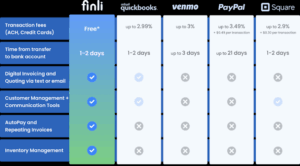
Finli provides financial institutions with the operational data that makes early lending conversations possible. When small businesses process payments, send invoices, and manage customers through Finli’s white-labeled platform, your institution gains real-time visibility into the signals that predict lending needs months in advance.
The platform surfaces the metrics that matter for proactive outreach: revenue trends visible through payment volume, collection efficiency through accounts receivable aging, customer acquisition through new payment sources, and seasonal patterns across multiple cycles. Relationship managers can see which clients are growing, which are facing cash flow pressure, and which are approaching predictable capital needs, all before the business owner ever articulates a request.
This changes the character of lending conversations entirely. Instead of reviewing applications from clients who’ve already decided to borrow, your relationship managers are initiating discussions grounded in specific observations about each business. The conversation starts from demonstrated understanding, not from a generic product pitch.
Finli integrates with Q2 and Jack Henry, requires no developer resources, and launches in under 24 hours. The “Try Before You Integrate” model lets you start surfacing lending signals from real client activity before committing to deeper system integration.
Takeaways
Small business lending opportunities are often lost in the gap between when a business first recognizes a need and when they formally apply. By the time an application arrives, the business has frequently already decided where they’re going. The institutions winning more of these deals aren’t winning on speed or rate. They’re winning by starting the conversation months earlier, grounded in real-time visibility into how their clients are actually operating.
Proactive lending conversations depend on seeing growth trends, collection patterns, seasonal cycles, and customer acquisition activity as they emerge, not after they show up in financial statements months later. This visibility is what separates reactive lending, where you process applications from clients who already know what they want, from strategic lending, where you identify opportunities early and position your institution as the obvious partner.
Finli enables financial institutions to make this shift by providing the operational platform that generates the real-time intelligence proactive lending requires. The best lending conversations start months before the application, and they start with understanding what’s actually happening in the business.