
Not every small business has the same operational needs. A retail shop that processes point-of-sale transactions all day operates differently than a contractor who invoices clients after completing a project. A property manager collecting rent from 30 tenants has different pain points than a consultant billing retainers by the hour. When financial institutions decide to offer operational tools like invoicing, payment collection, and customer management, the natural question is: where do we start?
The answer matters because targeting the right segments first generates faster adoption, stronger results, and better internal evidence that the investment is working. Financial institutions with industry-specific strategies see 4-7% higher revenue growth compared to those with generalized approaches. Starting with the segments that benefit most creates momentum. Starting with the wrong ones creates doubt.
(Source: McKinsey Financial Services Technology Report)
What Makes a Segment a Good Fit
The small business segments that benefit most from operational tools share a few characteristics. Not every segment needs to check every box, but the more of these traits a business type has, the more naturally it fits.
They invoice clients rather than process point-of-sale transactions. Businesses that send invoices and wait for payment, contractors, consultants, property managers, service providers, experience the collection delays, the follow-up burden, and the cash flow timing gaps that operational tools directly address. A business that collects payment at the register has a different set of needs.
They have recurring client relationships. Businesses that serve the same customers repeatedly, property managers collecting monthly rent, consulting firms billing ongoing retainers, HVAC companies with maintenance contracts, benefit most from customer management and AutoPay because these tools turn irregular revenue into predictable monthly income. One-time transaction businesses see less value from recurring billing features.
They spend significant time on administrative work. Small business owners spend an average of 14 hours weekly on administrative tasks, but that number is much higher for businesses managing complex client relationships, multiple projects, or high invoice volumes. The segments where administrative burden is highest are the ones where time savings from operational tools feel most immediate.
(Source: NFIB Small Business Economic Trends)
They experience cash flow timing pressure. Businesses where the gap between completing work and receiving payment creates regular cash flow challenges benefit directly from tools that accelerate collection. 56% of small businesses are currently owed money from unpaid invoices. The segments where that percentage is highest are the ones where faster payment collection makes the biggest difference.
(Source: Intuit QuickBooks 2025 Late Payments Report)
The Segments That Tend to Benefit Most
Based on these criteria, several business types consistently emerge as strong starting points for operational tool adoption.
Contractors and construction businesses operate on project-based cash flows with significant gaps between work completion and payment. They invoice clients for large amounts, often deal with progress billing, and spend considerable time managing quotes, invoices, and payment follow-up across multiple active projects. Collection delays hit them especially hard because their expenses (materials, labor, equipment) are front-loaded while payments come later.
Property management companies run on recurring revenue models with dozens or hundreds of individual payment relationships. Monthly rent collection, maintenance vendor payments, and tenant communication create constant administrative work. AutoPay and automated reminders transform their operations by converting manual rent chasing into predictable monthly income.
Professional services firms, including consultants, marketing agencies, and accounting practices, work with time-based billing and ongoing client retainers. They manage complex client relationships, track project profitability, and deal with clients who frequently pay on longer timelines. Integrated invoicing and customer management directly address their daily workflow.
Service-based businesses like HVAC companies, plumbing services, and electrical contractors need mobile-friendly invoicing, payment processing for on-site collections, and recurring billing for maintenance contracts. They’re often in the field and need tools that work from a phone, not a desktop. The ability to send an invoice and collect a payment immediately after completing a service call changes their cash flow dynamics entirely.
These four segments share an important trait: when they adopt operational tools through their financial institution, the impact is visible almost immediately. Collection times drop, deposits become more predictable, and engagement with the platform happens daily rather than monthly. That quick, measurable impact is what builds internal confidence to expand to additional verticals.
How to Evaluate Your Own Portfolio
The best starting point isn’t a national trend. It’s your existing customer base. Your portfolio already contains the data you need to identify which segments will adopt operational tools most readily.
Look at your current business accounts by industry. Where do you have the highest concentration of similar businesses? If you already serve 15 property management companies, you understand their challenges and have a natural test group for operational tools. Existing relationships are easier to expand than new ones are to build.
Identify which business types generate the most total relationship value, not just deposit balances, but loans, processing revenue, and fee income combined. The segments producing the highest relationship value are often the ones with the most to gain from deeper operational engagement.
Listen for repeated pain points. If your relationship managers consistently hear contractors mention payment follow-up, or property managers describe the hours they spend on rent collection, those patterns indicate segments where operational tools will land immediately.
Evaluate your local business ecosystem. Some markets have natural clusters: a college town with many property managers, a growing suburb with active construction, a professional services corridor downtown. Your geographic reality shapes which segments represent the biggest opportunity.
Consider starting with a single vertical and going deep rather than spreading across several at once. An institution that becomes known as the bank that truly understands property management in their market builds a reputation that generates organic referrals within that community. Property managers talk to other property managers. Contractors recommend tools to other contractors. Vertical depth creates a referral engine that horizontal breadth cannot.
How Finli Supports Multi-Segment Deployment
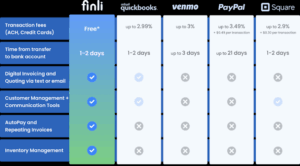
Finli’s platform is designed to serve multiple business verticals through a single configurable system. Rather than building separate solutions for each segment, Finli provides integrated invoicing, payment processing with 0% ACH fees, AutoPay, automated reminders, customer management, and real-time business insights that adapt to different industry workflows under your brand.
A property manager uses the same platform to collect rent and manage tenants that a contractor uses to send project invoices and track payments. The core capabilities, getting paid faster, managing customers, and gaining cash flow visibility, apply across segments even though the specific workflows differ.
This means your institution can start with the highest-opportunity segment, prove adoption and results, and expand to additional verticals without deploying new technology. Finli integrates with Q2 and Jack Henry, requires no developer resources, and follows a “Try Before You Integrate” model that lets you test with real clients before scaling.
Takeaways
The small business segments that benefit most from operational tools are those that invoice clients, maintain recurring relationships, spend significant time on administration, and experience cash flow timing pressure. Contractors, property managers, professional services firms, and field service businesses consistently check these boxes.
Start with your own portfolio. The segments where you already have concentration, relationship depth, and repeated pain points are the ones where operational tools will generate the fastest adoption and the clearest results. Use those early wins to build the case for expanding to additional verticals.
Finli enables financial institutions to serve multiple segments through a single platform, starting with the highest-opportunity verticals and expanding as adoption grows. The institutions that target strategically rather than broadly will see stronger results and build momentum faster.