
A contractor drives between job sites all day, sends invoices from their phone at night, and spends Sunday mornings following up with clients whose payments are a week late. A property manager juggles tenant requests, maintenance coordination, and rent collection across twenty units. A consulting firm owner bills clients in fifteen-minute increments, manages three simultaneous projects, and tries to keep track of which retainers are running low on hours. None of these people are thinking about their checking account during their workday. They’re thinking about whether they’ll get paid, how long the next project will take, and what’s going to break their week.
This is the gap between how financial institutions understand their small business clients and how those clients actually run their businesses. Banks see account activity, loan performance, and quarterly reviews. Business owners live in a different reality where administrative work eats into weekends, scattered systems create constant friction, and the bank is peripheral to almost every decision they make during the day. Closing that gap changes everything about how FIs can serve this segment.
The Daily Reality Most FIs Miss
Small business owners spend an average of 14 hours weekly on administrative tasks: creating invoices, chasing payments, reconciling transactions across systems, updating customer records, and managing the operational logistics that keep their businesses running. That’s nearly two full workdays every week spent on activities that don’t generate a dollar of revenue.
Most of this work happens outside normal business hours. Business owners send invoices at 10 PM after their kids go to bed. They reconcile transactions on Saturday mornings. They chase late payments during the few minutes they have between client calls. The cost isn’t just time. It’s attention. Every hour spent on administrative work is an hour not spent on growth, relationships, or strategy. And it’s exhausting in ways that don’t show up in any business metric your institution tracks.
This reality shapes what small business owners want from a financial partner, and it rarely matches what banks are actively offering. They don’t want another product. They want fewer systems to manage, faster access to the money they’ve earned, and tools that help them stop working two jobs (running their business and running the administration of their business) at the same time.
(Source: NFIB Small Business Economic Trends)
What They Wish You Understood
Small business owners navigate several realities that most banking conversations never touch.
They’re Focused on Running the Business, Not the Finances
Most small business owners didn’t start their company because they love accounting. A contractor loves building things. A consultant loves solving problems. A property manager loves real estate. The financial side of the business is a necessary task, not a passion. When a bank assumes the owner is fluent in cash flow terminology, treasury management options, or working capital structures, it creates distance. The most effective conversations meet business owners in their language: how long until I get paid, how much is in my account right now, what do I need to do to be ready for tax season.
They Often Don’t Have Real-Time Visibility Into Their Own Numbers
A business owner rarely has real-time visibility into their own operations. Their accounting software is updated weekly, or monthly, or whenever they remember. Their cash flow estimate is often just a gut feeling based on what they remember billing and what’s due soon. When a banker asks “how’s business?” during a quarterly review, the honest answer is often “I’m not entirely sure.” This isn’t irresponsibility. It’s the reality of running a small business without the financial infrastructure larger companies take for granted.
They Rarely Raise Operational Challenges on Their Own
A contractor whose biggest client is paying 45 days late isn’t going to volunteer that information to their banker. They’re going to try to manage through it. A consulting firm losing a major account won’t call the bank until the next loan payment is due. This silence isn’t about trust. It’s about not viewing the bank as relevant to operational problems, an assumption that’s been reinforced by every interaction where the bank led with products rather than help.
They Choose Tools That Solve the Problem in Front of Them
When a business owner needs to accept a payment on a job site, they download Square and start using it within the hour. They’re not comparing merchant processing options or thinking about deposit concentration. They’re solving an immediate problem. This is how fintech platforms capture small business relationships: one practical need at a time. 84% of small businesses in the U.S. now use at least one fintech service, primarily for payment processing, because those platforms were there when the problem appeared.
(Source: CoinLaw Research on SME Fintech Usage)
They Value Concrete Help Over Broad Commitments
Overall small business banking satisfaction increased 11 points in 2025, driven primarily by financial health support and communication, not by product features or rates. What actually moves the needle for business owners is whether their bank helped them with something concrete. A conversation that saves them time, a tool that makes their operations easier, a proactive outreach about an opportunity they hadn’t noticed. These are the moments that reshape how a business owner views their institution.
(Source: J.D. Power 2025 U.S. Small Business Banking Satisfaction Study)
Why the Gap Persists
Financial institutions don’t miss the operational reality of small businesses because they don’t care. They miss it because the traditional banking relationship is structured around scheduled interactions and standardized products, not daily operations. A quarterly review happens once every three months. A loan application happens once every few years. Daily work happens every day. The mismatch means banks are measuring a relationship through snapshots while the business owner is living a continuous reality.
The fix isn’t more frequent check-ins. Business owners don’t have time for more meetings. The fix is being present in the operational work itself, providing the tools a business uses daily so that the relationship exists in the flow of actual work rather than in scheduled conversations about it.
This is what 47% of small business clients are describing when they cite dedicated relationship manager support as a top criterion for choosing their primary bank. They’re not asking for someone to check in quarterly. They’re asking for someone who knows what’s happening in their business without them having to explain it.
(Source: McKinsey Banking Matters)
How Finli Closes the Gap
Finli provides financial institutions with the operational platform that bridges the gap between how banks traditionally engage and how small businesses actually work. When a client sends invoices, collects payments, manages customers, and tracks cash flow through Finli’s white-labeled tools, your institution becomes part of their daily workflow instead of a peripheral touchpoint.
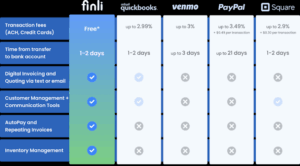
The platform handles the work that consumes business owners’ 14 weekly administrative hours: professional invoicing, 0% ACH payment collection, automated reminders, AutoPay for recurring revenue, customer management, and real-time cash flow visibility. Business owners spend less time on administration and more time on the work that actually grows their business.
For your institution, this shift creates something traditional banking relationships cannot: continuous visibility into how clients actually operate. You can see revenue trends as they emerge, spot collection challenges before they become cash flow problems, and have conversations grounded in what’s really happening rather than what a quarterly statement suggested.
Finli integrates with Q2 and Jack Henry, requires no developer resources, and launches in under 24 hours.
Takeaways
Your small business clients are living a different daily reality than the one your systems show you. They’re spending 14 hours a week on administrative work, making decisions with incomplete information, and choosing tools based on immediate practical needs rather than long-term banking strategy. The gap between how they actually work and how banks engage with them is where relationships erode, deposits leak, and fintechs capture the operational touchpoints that should belong to your institution.
Closing that gap requires being present in the work itself, providing tools that reduce administrative burden, accelerate payment collection, and create daily engagement rather than quarterly touchpoints. When your institution becomes part of how a business operates rather than something it uses occasionally, you’ve built a relationship that understands the business on its own terms.
Finli enables financial institutions to make this shift by providing the operational platform that matches how small businesses actually work. The institutions that meet their clients in this reality, not in the abstract space of products and quarterly reviews, will build the kind of engaged relationships that define modern small business banking.