
Most financial institutions already know they should be doing more for their small business clients. 80% of bank and credit union leaders say they want to expand SMB services. What tends to slow things down isn’t a lack of interest. It’s that the opportunity feels big but vague, and vague opportunities don’t get funded.
So here’s an attempt to make it concrete. The numbers behind small business services are surprisingly straightforward once you lay them out. The revenue opportunity is already sitting in your portfolio, the retention math strongly favors action, and the cost of getting started is a fraction of what most people assume.
(Source: Jack Henry 2025 Strategy Benchmark)
Your Clients Are Already Paying for These Services Elsewhere
75% of small businesses go outside their financial institution to meet at least one financial need. That’s three out of four of your existing business clients spending money on payment processing, invoicing, customer management, and cash flow tools with someone other than you.
Small businesses spend an average of $340 monthly on these disconnected operational tools. Across a portfolio of 500 business clients, that’s roughly $2 million per year in spending that could be flowing through your institution. This isn’t theoretical demand you’d need to create. It’s money your clients are already paying to Square, QuickBooks, Stripe, and a handful of other platforms to run their businesses.
Every invoice sent through an external platform, every payment processed outside your ecosystem, and every customer managed in a separate CRM represents fee income and deposit activity that belongs to someone else. The opportunity isn’t about convincing small businesses to buy something new. It’s about providing what they’re already buying, through you instead.
What’s worth noting is that small businesses would actually prefer to get these tools from their bank. They make decisions about invoicing, payment processing, and customer management at the same time they’re choosing their checking account and considering loans. These are financial tools, and getting them from a single trusted provider makes sense to most business owners. The barrier has never been demand. It’s been availability.
(Source: Datos Insights 2025 Matrix Report)
What Deeper Relationships Actually Produce
A business checking account generates $200-400 annually in fee income. That’s the number most people think of when they think about SMB relationships. It’s also dramatically incomplete.
When that same business processes payments, manages invoices, and runs daily operations through your platform, the economics shift. Small businesses using comprehensive operational platforms through their financial institution typically generate 3.2x more revenue through expanded service utilization, higher deposit balances, increased fee income, and stronger loan relationships.
(Source: American Bankers Association Commercial Banking Survey)
To put real numbers on it: a bank with 500 small business checking accounts averaging $300 in annual fee income is generating about $150,000 per year from that portfolio. If 200 of those businesses adopt integrated operational tools, each relationship jumps to $4,200-4,800 annually through combined processing revenue, platform fees, and higher deposit balances. That’s over $900,000 in annual revenue from 40% of the portfolio.
Deposit growth makes the picture even stronger. Institutions implementing comprehensive business platforms report deposit levels increasing 25-35% within six months of payment integration. When payments process through your platform instead of an external processor, funds settle directly into accounts at your institution rather than sitting in Square’s ecosystem for days before transferring.
The Retention Math Works in Your Favor
Here’s where the numbers get especially compelling. Customer acquisition costs keep rising, and 68% of small business relationships show declining engagement within the first 18 months. Many of those accounts end up existing in name only, with the real financial relationship happening through fintech platforms.
Meanwhile, small businesses that maintain strong engagement through year two show 73% higher lifetime value and 89% lower churn rates. Acquiring new clients costs 5-7x more than retaining existing ones.
(Source: Banking Administration Institute Customer Retention Study)
37% of small businesses are considering switching institutions within two years. That number jumps to 44% among millennial and Gen Z-led businesses. Operational tools directly address this by creating daily engagement that makes your institution harder to leave. Digital-first customers exhibit an 88.4% retention rate, higher than multi-channel averages. When businesses run their invoicing, payments, and cash flow through your platform, switching means disrupting workflows and migrating data, not just moving a checking account.
(Source: CoinLaw Banking Customer Retention Statistics 2025)
The investment in small business services is as much about protecting the clients you have as it is about attracting new ones. And the data from J.D. Power’s 2025 study reinforces this: overall small business banking satisfaction increased 11 points, driven primarily by financial health support and communication. The institutions that are winning on retention aren’t doing it with rates. They’re doing it by helping businesses operate better.
(Source: J.D. Power 2025 U.S. Small Business Banking Satisfaction Study)
It Costs Less Than You Think to Start
This is usually where conversations about expanding SMB services stall. Someone mentions a new technology platform and the room immediately thinks multi-year timeline, millions in development, and IT resources you don’t have. That assumption made sense five years ago. It doesn’t anymore.
Building comprehensive business platforms internally typically requires over $20 million and 2-3 years. That’s real, and it’s why most institutions haven’t gone this route. But white-label partnerships have fundamentally changed the math.
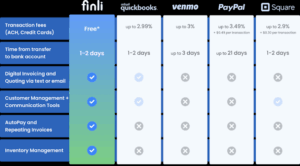
Finli provides financial institutions with complete operational tools: invoicing, payment processing with 0% ACH fees, AutoPay, automated reminders, customer management, and real-time business insights, all under your brand. Implementation requires no developer resources and can launch in under 24 hours.
Finli’s “Try Before You Integrate” approach is designed for exactly this situation. Instead of a large upfront commitment, you launch a pilot with real clients, generate fee income immediately, and use actual adoption data to decide how deep to go. Prebuilt integrations with Q2 and Jack Henry are available when you’re ready for them, but they’re not required to start. You’re testing with minimal risk, not betting on a multi-year build.
That distinction matters for how these conversations go internally. The difference between “we need to build a platform” and “we can pilot this next month and see what happens” is usually the difference between a stalled initiative and one that moves forward.
The Competitive Clock Is Ticking
More than half of small businesses in the U.S. now use fintech services for payment processing, invoicing, and cash flow management. These tools aren’t niche anymore. They’re how small businesses operate. Every month your institution doesn’t offer comparable capabilities is another month where external platforms become more embedded in your clients’ daily routines.
And for institutions where CRA performance matters at the leadership level, small business services that support operational health and financial literacy align naturally with Community Reinvestment Act objectives. Finli’s status as a Public Benefit Corporation strengthens this alignment, adding a regulatory benefit on top of the commercial one.
(Source: BAI Banking Strategies)
Takeaways
The numbers behind expanding small business services point in one direction. Your clients are already spending $340 monthly on tools you could provide. Deeper relationships generate 3.2x more revenue than checking accounts alone. Deposits grow 25-35% when payments process through your platform. Retention improves dramatically when you’re part of daily operations rather than an occasional touchpoint.
The cost of getting started has dropped significantly. White-label platforms like Finli eliminate the need for internal development, launching in under 24 hours with no developer resources required. The “Try Before You Integrate” model lets you prove the opportunity with real clients before committing further. The question at this point isn’t really whether the investment makes sense. It’s how quickly you can start capturing the revenue and relationships that are currently going elsewhere.