
A new contractor finishes their first job and needs to get paid. That’s the very first business problem they solve. They google “how to send a professional invoice,” find FreshBooks, and sign up. The next question is where that payment should go, so they open a business checking account. A week later, a client asks to pay by card. The contractor downloads Square. Two weeks after that, they need to track which clients owe them money. They start a spreadsheet or sign up for a basic CRM.
The order matters. The contractor didn’t start by choosing a bank and then asking what tools it offered. They started by figuring out how to get paid, found a platform that solved that problem, and then opened a bank account as the place for those funds to land. The bank entered the picture after the operational decisions were already made. By the time the contractor has been in business for 90 days, their entire daily workflow runs through tools they found on their own. The bank holds the account. Everything else belongs to someone else.
This pattern plays out across industries and business sizes. The first question a new business owner asks isn’t “where should I bank?” It’s “how do I get paid?” or “how do I send an invoice?” The tools that answer those questions become the operational foundation, and the bank becomes a secondary piece of infrastructure. 84% of small businesses in the U.S. now use at least one fintech service, with payment processing as the primary driver. These adoption decisions happen early, happen fast, and create habits that are difficult to change later.
(Source: CoinLaw Research on SME Fintech Usage)
Why Getting Paid Comes Before Choosing a Bank
The timing matters more than most financial institutions realize. A business owner’s first operational need is almost always revenue-related: how do I invoice this client, how do I collect this payment, how do I track who owes me money. These questions get answered immediately, often the same day the need arises. The bank decision comes later, sometimes weeks later, as a downstream step: “now where should this money go?”
This sequence means that by the time a business owner walks into a branch or opens a checking account online, they’ve already adopted the platforms that will define their daily operations. The bank gets the account. The fintech gets the relationship.
The pattern deepens over time. A property manager starts using PayPal to collect rent digitally, discovers it’s easier than chasing checks, then adds a separate invoicing tool for maintenance fees and late charges. Within a few months, most of their financial activity runs through platforms outside their bank. Contractors follow a similar path through QuickBooks, and consulting firms often build around Stripe. Each platform starts as a single-purpose tool and expands into a broader financial relationship.
The result is that the operational relationship gets established before the banking relationship has a chance to expand. A business that adopts Square for payments in month one isn’t going to switch to a bank-provided alternative in month six unless the alternative offers a significant improvement. The switching cost isn’t financial. It’s the effort of changing workflows, migrating data, and relearning systems. Once operational habits form, they stick.
Small businesses spend an average of $340 monthly on these operational tools. Across your portfolio, that’s revenue flowing to platforms that got there first, not because they were better, but because they were present when the need appeared.
(Source: Datos Insights 2025 Matrix Report)
Why Being Present at the Right Moment Changes Everything
The opportunity for financial institutions is to be part of the answer when business owners ask their first operational question. If the first tool a business adopts for getting paid also happens to be connected to a bank account, the entire sequence changes. Instead of finding tools first and a bank second, the business gets both at once.
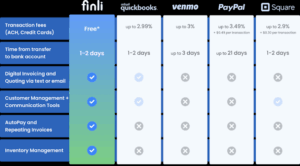
Consider the difference. A business owner signs up with an institution that offers integrated invoicing, payment processing with 0% ACH fees, and customer management tools from the start. Their first invoice goes out through the bank’s platform. Their first payment comes in through the bank’s system. Their customer records start building in the bank’s CRM. The operational relationship and the banking relationship are the same thing from day one.
Now compare that to the typical experience: a business owner opens a checking account, gets a debit card and online banking login, and walks out with no operational tools. Within a week, they’ve signed up for three external platforms to handle the work that actually runs their business. By month three, those platforms are essential to their daily operations. The bank holds the account. Someone else holds the relationship.
The institutions seeing the strongest results are the ones that position operational tools during onboarding, before the business owner starts looking elsewhere. When businesses adopt operational tools through their bank from day one, they form habits that create lasting engagement. Small businesses that maintain strong engagement through year two show 73% higher lifetime value and 89% lower churn rates.
(Source: Banking Administration Institute Customer Retention Study)
The Compounding Effect of Early Adoption
When a business builds its operations on your platform early, the advantages compound over time. Every invoice sent creates a data point. Every payment collected generates a transaction record. Every customer added builds a relationship history. After six months, the business has an operational foundation on your platform that represents real value, both to them and to your institution.
For the business, this means consolidated tools, cleaner records, and better cash flow visibility. For your institution, this means deeper deposits, richer data for lending decisions, real-time visibility into business health, and a relationship that competitors can’t replicate with a better rate.
The reverse is also true. When a business builds its operational foundation on external platforms, each month that passes makes the alternative harder to displace. The contractor who has twelve months of invoicing history in FreshBooks, a full customer database in a separate CRM, and payment processing flowing through Square isn’t going to migrate all of that to a new system unless the new system offers dramatically more value. The window for capturing the operational relationship narrows quickly.
This is why timing matters more than features in early-stage business relationships. An adequate tool offered at the right moment will consistently beat a superior tool offered six months later.
How Finli Helps You Get There First
Finli provides financial institutions with the operational platform that lets you be present when small businesses make their earliest tool decisions. The platform offers integrated invoicing, payment processing with 0% ACH fees, AutoPay, automated reminders, customer management, and real-time cash flow visibility, all under your brand and available from the moment a business opens an account.
Because Finli launches in under 24 hours with no developer resources required, your institution can start offering operational tools immediately rather than waiting for a lengthy implementation cycle. The “Try Before You Integrate” approach means you can pilot with new business clients and measure adoption before committing to deeper system integration through Finli’s prebuilt Q2 and Jack Henry connections.
The competitive advantage is straightforward: the institution that provides operational tools during onboarding captures the operational relationship. The one that waits spends the next two years trying to displace tools that got there first.
Takeaways
Small businesses look for ways to get paid before they look for a bank. The tools that answer that first question become the operational foundation, and the bank becomes a secondary piece of infrastructure that holds the account but doesn’t hold the relationship. By the time a financial institution has a chance to offer operational tools, the business has usually already built workflows around external platforms that are difficult and disruptive to replace.
The institutions winning these relationships are the ones that combine operational tools with banking from the start, so that the first invoicing tool, the first payment system, and the first customer management platform are all connected to the bank account. This changes the entire sequence from “tools first, bank second” to “everything in one place from day one.”
Finli enables financial institutions to be present at this critical moment, providing white-labeled operational tools so that when a business asks “how do I get paid?” the answer is your institution, not someone else’s platform. In small business banking, being first matters more than being best.