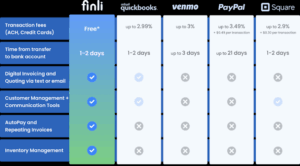

Financial institutions already provide small business customers with a range of payment capabilities. ACH transfers, wire payments, merchant processing, and in many cases invoicing tools are standard offerings. These are valuable foundations. But there’s a category of payment tools that most institutions either don’t offer or don’t actively promote, and it’s the category that has the most direct impact on how reliably and quickly small businesses collect revenue from their own customers.
Payment automation tools, including recurring billing, invoices with AutoPay functionality, and automated collection reminders, help small businesses convert unpredictable revenue into predictable monthly income. When a consulting firm can put its retainer clients on automatic monthly billing, or a property manager can set tenants up for recurring rent payments, the cash flow dynamics of the business change immediately. Revenue that used to arrive unpredictably, after invoicing, reminding, and waiting, starts arriving on the same date every month. For your institution, that predictability means more stable deposits, better loan performance, and deeper platform engagement.
56% of small businesses are currently owed money from unpaid invoices, with the average outstanding amount at $17,500. Payment automation tools directly address this by removing the manual collection effort and payment friction that cause delays between the businesses you serve and the customers who owe them money.
(Source: Intuit QuickBooks 2025 Late Payments Report)
Why These Tools Get Overlooked
Even when payment automation tools are available, adoption tends to lag behind other features like invoicing and digital payment links. There are a few specific reasons small business customers don’t take advantage of recurring billing and AutoPay functionality for their own client relationships.
Business owners don’t realize these tools apply to their type of business. Many owners associate automatic payments with subscription services or utility bills, not with their consulting retainers, maintenance contracts, or monthly rent collection. A contractor with three clients on recurring service agreements doesn’t think of themselves as having a “subscription model,” even though the payment structure is identical. When the feature is described as “set up recurring billing for your clients,” it clicks for some businesses. When it’s positioned more specifically, “put your retainer clients on automatic monthly payments so you never chase that invoice again,” it clicks for many more.
The onboarding conversation focuses on invoicing first. When a business starts using operational tools, the natural first step is sending invoices and collecting one-time payments. Recurring billing and AutoPay functionality feel like advanced features to set up later. But “later” often means never, because the business forms a habit around the manual invoice-and-collect workflow and doesn’t revisit the setup.
Business owners worry about their customers’ reactions. Some owners hesitate to offer automatic billing because they think it feels aggressive or presumptuous. In reality, many of their clients would prefer it. Automatic payments are standard in consumer transactions, and business clients increasingly expect the option. A tenant who can set up automatic rent payments or a retainer client who doesn’t have to remember to pay an invoice every month experiences the convenience as a benefit, not an imposition.
How Payment Automation Changes Cash Flow for Your Business Customers
The impact on a small business’s cash flow is straightforward but significant. When a business enables recurring billing or AutoPay for its own clients, the collection variable disappears entirely for every enrolled customer.
A consulting firm with 10 retainer clients billing $5,000 monthly has $50,000 in recurring revenue. If those clients pay manually, the firm might collect $30,000 by the 15th of the month and wait until the 30th or later for the rest. If eight of those clients are enrolled in automatic monthly billing, $40,000 arrives on the first of the month, every month. The firm knows exactly what’s coming and when. Payroll, rent, and loan payments can be planned with confidence rather than hope.
For property managers, the impact is even more pronounced. A manager with 25 units collecting $1,500 average rent has $37,500 in monthly revenue. Manual collection means checks arriving over the first two weeks, follow-up calls, and a handful of tenants who consistently pay late. Automatic rent collection for 20 of those tenants means $30,000 arrives on the first. The manager’s time shifts from chasing payments to managing properties.
Small businesses more affected by late payments are 1.7x more likely to rely on credit. Payment automation directly reduces that reliance by making revenue predictable. When businesses know exactly when income from their clients will arrive, they draw less on credit lines, maintain healthier deposit balances, and make more consistent loan payments.
(Source: Intuit QuickBooks 2025 Late Payments Report)
What It Means for Your Portfolio
When your small business customers use payment automation tools to collect from their own clients more reliably, the benefits flow directly into your portfolio.
Deposits become more predictable. When a business’s customers pay automatically on set dates, those funds arrive at your institution on a known schedule rather than in irregular waves. This predictability strengthens your funding position and makes deposit forecasting more reliable.
Loan performance improves. Businesses with predictable monthly income from their clients make predictable loan payments to you. The timing gaps that cause occasional missed payments, a business waiting on a check from their customer that hasn’t arrived yet, largely disappear when a meaningful portion of revenue is collected automatically.
Engagement deepens. Every client a business enrolls in recurring billing is another thread connecting them to your platform. A business with 15 of their own customers on automatic payments through your system has 15 recurring reasons to stay. The switching cost isn’t about the checking account anymore. It’s about disrupting a payment infrastructure that runs automatically every month.
How to Drive Adoption of Payment Automation Tools
The fix is mostly about how relationship managers introduce and position these capabilities when talking with business customers.
Make it part of the onboarding conversation, not a follow-up. When a business sets up invoicing on your platform, the next sentence should be: “For any clients you bill on a recurring basis, let’s set up automatic billing so those payments come in every month without you having to chase them.” Position it as the natural next step, not an advanced feature.
Use specific language that matches the business type. “Put your retainer clients on automatic monthly billing” for consultants. “Set up automatic rent collection for your tenants” for property managers. “Automate your maintenance contract payments” for service businesses. The more specific the language, the faster the business owner sees the relevance to their own client relationships.
Show the math. “You have eight recurring clients. If they’re all on automatic billing, that’s $X arriving on the first of every month without you doing anything.” Concrete numbers make the value tangible in a way that feature descriptions don’t.
How Finli Delivers Payment Automation to Your Business Customers
Finli’s recurring billing and AutoPay functionality is built into the same platform where businesses send invoices and collect payments. A business’s clients authorize payment once, and charges process automatically on schedule through 0% ACH processing. The business owner doesn’t manage a separate system. Automatic billing is simply how certain client relationships are handled, within the same workflow they already use daily.
For your institution, every recurring payment enrollment means a deposit that arrives predictably, deepens platform engagement, and strengthens the relationship. Finli surfaces which of your business customers have recurring client relationships that could benefit from automatic billing, giving relationship managers a specific conversation starter grounded in the business’s actual payment patterns.
Finli integrates with Q2 and Jack Henry, requires no developer resources, and launches in under 24 hours.
Takeaways
Payment automation tools, including recurring billing, AutoPay functionality, and automated reminders, are among the highest-impact operational capabilities a financial institution can offer its small business customers. These tools help businesses collect from their own clients more reliably, converting unpredictable revenue into predictable monthly income. Yet adoption tends to lag because business owners don’t realize their retainers, maintenance contracts, and recurring client relationships are ideal candidates for automatic billing.
The benefits compound across the relationship. For the business: predictable revenue from their clients, less time chasing payments, reduced credit reliance. For your institution: predictable deposits, better loan performance, deeper engagement, and higher switching costs. Helping your small business customers set up payment automation for their own client relationships is one of the simplest, highest-return actions available.