
A landscaping company generates 70% of its annual revenue between April and October. A consulting firm loses its biggest client in January and spends six weeks rebuilding the pipeline. A property manager’s occupancy dips during winter months and rent collection slows. Each of these businesses faces a predictable cash flow gap. A loan or credit line draw is one way to help, and often the right one. But it’s not the only way, and for many businesses, it works best when paired with operational support that addresses the underlying timing problem.
78% of small business owners report that cash flow management keeps them up at night more than any other financial concern. For many of them, the pressure isn’t about a lack of capital. It’s about the timing mismatch between when money comes in and when it goes out. Financial institutions that can offer a full range of support during slow seasons, lending when it’s needed, plus operational tools that accelerate collections, reduce costs, and improve visibility, become the kind of partner that businesses rely on year-round.
(Source: National Federation of Independent Business)
The Timing Problem Behind Most Slow Seasons
When people think about seasonal businesses, they picture the obvious examples: landscapers in winter, tax preparers in summer. But most small businesses experience some form of seasonality, and the cash flow pressure it creates is rarely about total revenue. It’s about timing.
A contractor might earn plenty of money over the course of a year, but if their biggest project payments cluster in Q2 and Q4 while expenses run steadily every month, they experience real cash flow pressure in Q1 and Q3. The business doesn’t need more money. It needs the money it’s already earned to arrive faster, and its outflows to align better with its income patterns.
This is an important distinction for financial institutions. When a business owner walks in during a slow month looking stressed about cash flow, a credit line or short-term loan might be exactly the right solution. But if the underlying issue is also slow-paying customers, irregular collection timing, or misaligned expenses, pairing that lending support with operational tools addresses the root cause alongside the immediate need. The business gets through the slow month and enters the next one in a stronger position.
Getting Paid Faster Changes the Math
The single most impactful operational support a financial institution can offer alongside lending is helping businesses collect the money they’ve already earned more quickly. The average small business waits 29 days to collect on net-30 invoices, with many waiting 45 to 60 days. During a slow season, those extra weeks of waiting can be the difference between making payroll comfortably and scrambling.
(Source: QuickBooks Payment Timing Report)
Automated payment reminders reduce collection times significantly. When a business sends an invoice with a one-click digital payment link and the system follows up automatically at set intervals, customers pay faster because the friction of paying has been removed. The business owner doesn’t have to spend hours making phone calls and sending follow-up emails during a period when they’d rather be focused on generating new work.
AutoPay for recurring clients changes the seasonal math even further. A property manager who has tenants on AutoPay doesn’t experience the same collection slowdown during winter months. A consulting firm with retainer clients on automated monthly billing maintains a baseline of predictable revenue even when new project work slows. Converting irregular revenue into predictable monthly income is one of the most effective defenses against seasonal pressure, and it reduces the amount of credit a business needs to draw during slow months.
Reducing Costs During Low-Revenue Periods
The other side of the timing equation is outflow. Small businesses spend an average of $340 monthly on disconnected financial tools: separate invoicing platforms, payment processors, customer management systems, and accounting integrations. During a high-revenue month, $340 feels manageable. During a slow month, it’s one more drain on already tight cash flow.
(Source: Datos Insights 2025 Matrix Report)
Consolidating these tools into a single integrated platform reduces costs directly. But the savings go beyond subscription fees. When invoicing, payment collection, and customer management run through one system, the business owner spends less time on reconciliation, less time switching between platforms, and less time on the administrative work that consumes an average of 14 hours per week. During a slow season, that reclaimed time can go toward business development, client outreach, and the activities that generate the revenue to fill the gap.
(Source: NFIB Small Business Economic Trends)
Processing fees add another layer. A business paying 2.6-3.5% in transaction fees to an external payment processor is losing a meaningful percentage of every dollar collected. During a slow season when margins are already tight, those fees hurt more. Switching to 0% ACH processing keeps more of each payment in the business owner’s account.
Using Visibility to Plan Ahead
Seasonal pressure is most painful when it arrives as a surprise. A business owner who knows that January will be slow can prepare in November. One who doesn’t realize the pattern until they’re already in the middle of it is left reacting.
This is where operational data creates real value. When a financial institution can see a client’s revenue patterns across multiple cycles, they can help the business plan for predictable slowdowns rather than scramble through them. A relationship manager who reaches out in October to say, “Based on your patterns, January looks like it’ll be lighter. Here are a few things you can do now to prepare,” is providing the kind of support that business owners remember.
That conversation might include tightening collection processes before the slow period, converting key clients to AutoPay while revenue is strong, building a cash reserve during peak months by setting aside a percentage of each payment, reviewing which expenses can be adjusted seasonally, and establishing a credit line in advance so it’s available if needed. Some of these are lending conversations. Others are operational. Together, they give the business a complete strategy for the slow period rather than a single solution.
How Finli Helps Business Clients Manage Seasonal Pressure
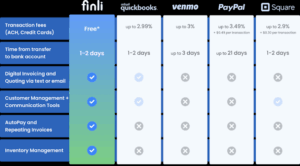
Finli provides financial institutions with the operational tools that address seasonal cash flow at the source. Automated payment reminders and one-click digital payment links help businesses collect faster. AutoPay converts irregular revenue into predictable monthly income. 0% ACH processing eliminates the transaction fees that erode margins during tight months. And consolidated invoicing, payment, and customer management tools reduce the $340 monthly cost of disconnected systems.
For relationship managers, Finli’s real-time data reveals the seasonal patterns that enable proactive conversations. You can see which clients are approaching historically slow periods and reach out with practical guidance before the pressure hits. This positions your institution as the partner that helped them prepare, combining the right lending products with the operational tools that strengthen cash flow at the source.
Finli operates under your brand, integrates with Q2 and Jack Henry, requires no developer resources, and launches in under 24 hours.
Takeaways
Lending is an important part of how financial institutions support small businesses through slow seasons. But it’s most effective when paired with operational tools that address the timing problems causing cash flow pressure in the first place. Helping businesses collect faster, reduce operational costs, and plan ahead using data from previous cycles strengthens the lending relationship and builds a broader kind of trust.
When a financial institution helps a business owner prepare for a slow quarter with a combination of a credit line, faster payment collection, and proactive planning, that experience reshapes the relationship. The business owner sees an institution that understands how their business works across the full year, not just when they need capital. That kind of support drives the loyalty and engagement that keeps the relationship growing.