
A freelance consultant deposits client payments into their personal checking account. A contractor pays for materials with a personal credit card. A property manager tracks rental income in the same account where their mortgage payment comes out. From a banking perspective, these businesses are invisible. They don’t have a business account, so they don’t show up in your small business portfolio, even though they have real revenue, real clients, and real operational needs.
There are roughly 30 million nonemployer businesses in the United States, and a significant portion operate entirely through personal accounts. 70% of businesses without a business bank account that applied for financing in the past two years were denied, largely because they lack the formal banking history lenders require. The irony is that many of these businesses are generating steady income and serving reliable clients. They just never made the switch to a separate business account.
For financial institutions, this represents both a risk and an opportunity. The risk is that these businesses are already your customers, running business revenue through personal accounts you don’t recognize as commercial activity. The opportunity is that helping them formalize creates a new business banking relationship from someone who’s already in your ecosystem.
(Source: Nav Business Banking Survey 2025)
Why They Don’t Make the Switch
Business owners who commingle personal and business finances aren’t being careless. They’re making practical decisions based on how they see their business and what they understand about the alternatives.
Many don’t see themselves as having a “real” business yet. A graphic designer who freelances on the side doesn’t think of themselves as a business owner who needs business banking products. A handyman who picks up jobs through word of mouth sees what they do as work, not a company. The identity gap between “I do freelance work” and “I run a business” prevents them from taking steps that feel premature.
The process of opening a business account feels heavy for a small operation. Documentation requirements, minimum balance expectations, and the formality of the application process can feel disproportionate for someone generating $3,000 a month in side income. When the personal account works fine for depositing checks, the effort of setting up a separate business account doesn’t seem worth it.
They don’t understand the benefits until they need them. Tax season is when most business owners first feel the pain of commingled finances, spending hours untangling business expenses from personal ones. But by then, they’ve been operating this way for a year and the habit is entrenched. The other consequences, difficulty qualifying for business credit, limited visibility into business performance, no clean financial history for lending, are problems they won’t encounter until they try to grow.
44% of small businesses don’t even apply for loans because they assume they won’t qualify. For businesses without formal financial separation, this assumption is often correct, not because the business is weak, but because there’s no documentation to prove it’s strong.
(Source: Canopy Small Business Lending Statistics 2025)
What It Costs Them (And You)
The downstream effects of commingled finances compound over time, for the business and for your institution.
Business owners lose visibility into their own performance. When business income and personal income flow through the same account, there’s no clean way to see revenue trends, track expenses, or understand cash flow timing. The business owner makes decisions based on their overall account balance rather than on how the business is actually performing.
Lending readiness is delayed. When a business eventually needs financing, they have no business banking history, no clean revenue data, and no separated financial statements. The application process becomes significantly harder, and the decline rate is much higher. Your institution loses a lending opportunity that could have been straightforward with even six months of separated financial history.
Your portfolio data is incomplete. If a meaningful number of small businesses in your market are running commercial activity through personal accounts at your institution, your small business metrics undercount the actual commercial relationship. You may have more small business customers than you realize, but you can’t serve them effectively because you can’t see them.
Making Formalization Feel Like an Upgrade
The institutions that successfully move business owners from personal to business accounts do so by making the transition feel like a step up rather than a bureaucratic hurdle.
Lead with operational tools, not the account. When the entry point is a professional invoicing platform or a payment collection tool rather than a business checking application, the business owner gets immediate value. A freelancer who starts sending professional invoices through your platform has a practical reason to separate their finances: they now have business revenue flowing through a system that works better when it’s connected to a business account.
Lower the barrier. Streamline the business account opening process for sole proprietors and freelancers. Many of these businesses don’t have complex structures or extensive documentation. An onboarding process designed for an LLC with multiple owners feels excessive for a solo consultant. Match the process to the business.
Show the tax season benefit early. One of the most compelling reasons to separate finances is cleaner tax preparation. When a business owner can see all their business transactions in one place, categorized and organized, the hours they used to spend at tax time sorting through personal and business expenses disappear. This is a tangible, near-term benefit that resonates with anyone who’s been through a messy tax season.
Connect formalization to future lending. Help business owners understand that building a business banking history now opens doors later. Six months of clean business account activity creates a foundation for credit decisions that commingled personal accounts cannot provide.
How Finli Creates the Path to Formalization
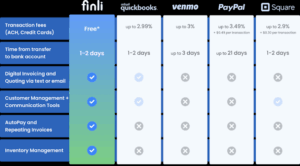
Finli provides financial institutions with the operational platform that makes formalization feel natural rather than bureaucratic. When a freelancer or sole proprietor starts using Finli’s white-labeled invoicing and payment collection tools, they immediately have a professional system for managing business revenue. That system works best when connected to a business account at your institution, creating a natural reason to open one.
The platform handles the daily work that drives the transition: professional invoicing, 0% ACH payment collection, automated reminders, customer management, and real-time cash flow visibility. As the business grows, the operational history on your platform becomes the foundation for lending conversations, relationship expansion, and deeper engagement.
Finli integrates with Q2 and Jack Henry, requires no developer resources, and launches in under 24 hours.
Takeaways
Millions of small businesses operate through personal accounts, not because they don’t need business banking, but because no one showed them why it matters or made the transition easy. These businesses have real revenue, real clients, and real operational needs. Many of them are already your customers, running commercial activity through personal accounts you don’t recognize as business relationships.
The institutions that help these businesses formalize will capture new business banking relationships from within their existing customer base. The key is leading with operational value, professional invoicing, payment tools, and customer management, rather than asking business owners to fill out an application for an account they don’t yet see the need for. When the tools create the value, the account follows naturally.