You completed the work on schedule. Your client was thrilled with the results. You sent an invoice. Then nothing. A week passes. Two weeks. You follow up awkwardly, wondering if they even received it. Another week later, payment finally arrives, but now your own bills are overdue and you’re scrambling to cover expenses.
This isn’t a one-time experience. It’s the pattern for most small business owners. Over half of small businesses are currently owed money from unpaid invoices, averaging $17,500 per business. Late payments aren’t just frustrating. They’re a cash flow crisis that threatens your ability to pay employees, cover rent, and invest in growth.
The problem isn’t that clients don’t want to pay you. It’s that your invoicing and payment process is creating friction that causes delays. The good news is that most of these delays are preventable. Understanding why they happen and fixing the underlying causes puts you back in control of your cash flow.
(Source: Swell)
The Hidden Reasons Invoices Go Unpaid
You probably assume clients pay late because they’re disorganized or cash-strapped. Sometimes that’s true. But research reveals a more actionable truth: 33% of companies cited invoicing their customers late as a major reason for delayed payments. This means many late payments are preventable through better processes on your end.
When you delay sending an invoice, you’ve already lost days before the clock even starts. A client completes work Tuesday. You don’t invoice until Friday. Their payment clock starts Friday, not Tuesday. You’ve surrendered a three-day advantage before anything else happens.
Unclear payment terms create confusion. Your client thinks payment is due in 45 days. You think it’s due in 30. They believe they’re still within the window. You believe they’re overdue. No one realizes the misalignment until weeks have passed.
Payment friction stops clients from paying. They receive your invoice but face obstacles. They need to write a check and find a stamp. They have to log into their banking portal and manually enter your account information. They can’t find a way to pay online. Each barrier increases the likelihood they set the invoice aside and forget about it. The longer it sits, the less likely they’ll ever pay in full.
Poor visibility into your invoice status means you don’t know when to follow up. Has the client seen the invoice? Are they working on payment? Is there a problem preventing payment? Without answers, you guess and risk either bugging them too soon or waiting too long.
(Source: Ready Credit)
Fix 1: Send Invoices Immediately
The moment work completes, invoice. Not end of day. Not end of week. As soon as the work is done and you can describe it accurately, send the invoice. Every day you delay is a day you’re not getting paid.
This isn’t about being aggressive. It’s about time. If you’re invoicing late, you’re automatically starting the payment clock later than necessary. A client who would pay in 30 days now pays in 40 because of invoicing delays. That’s 33% longer to wait for money that’s already yours.
For retainer clients with recurring invoices, automation solves this entirely. Set up recurring invoices that go out automatically on a fixed schedule. Your client receives the same invoice on the same date every month. You don’t forget, and they know exactly when to expect it.
Fix 2: Make Payment Terms Crystal Clear
Ambiguity about payment terms creates friction and confusion. Your invoice should state in plain language exactly when payment is due. Not “net-30” if your clients don’t understand what that means. State it outright: “Payment is due by [specific date].”
Include payment methods and instructions. If you accept ACH transfers, credit cards, and checks, list all three with instructions for each. If you prefer one method, say so. Making payment options obvious removes the barrier of clients not knowing how to pay.
For new clients, discuss payment terms before work starts. Include them in your contract or proposal. When terms are set upfront and clearly communicated, misunderstandings drop dramatically.
Fix 3: Eliminate Payment Friction
Every step between receiving your invoice and making payment is a friction point where the invoice gets set aside. Your goal is to remove every barrier.
Offer multiple payment methods. Some clients prefer ACH transfers. Others want credit cards. Some prefer digital wallets. When you force them into a single method, you’re creating friction. Removing that friction means payment happens faster.
Make payment a one-click action. The best invoices have a “Pay Now” button clients can tap directly from the email. No logging into separate portals. No navigating to your website. No copying account numbers. One tap, and payment completes. Invoices with embedded payment options get paid up to four times faster than those requiring manual processing.
Include all necessary information on the invoice. Account numbers, payment instructions, your contact information. Don’t make clients hunt for details. The more complete your invoice, the fewer reasons they have to delay payment.
Fix 4: Send Automated Payment Reminders
Clients intend to pay but forget. Your invoice gets buried in their email. A week passes. They see it again and think they already paid. Manual reminders create awkward follow-ups where you feel like you’re pestering them.
Automated reminders solve this. A friendly reminder goes out a few days before the due date. Another reminder arrives on the due date itself. Follow-ups continue automatically if payment becomes overdue. Your client stays informed without you having to personally follow up. The awkwardness disappears because it’s just your standard business process.
Automated reminders work on your schedule. You don’t have to remember who to follow up with or when. The system handles it every time, without exception.
Fix 5: Track Invoice Status in Real-Time
You can’t manage what you can’t see. Visibility into invoice status lets you intervene before payments age unnecessarily.
Know when clients view your invoices. If they’ve viewed it but haven’t paid, you can follow up with a specific ask instead of a generic “just checking in” message. If they haven’t viewed it, you know the invoice might be lost in email.
See payment status at a glance. Is the payment processing? Has it completed? Has it failed? When a payment fails, you know immediately and can help the client fix it instead of waiting weeks to discover they had a problem.
Categorize invoices by age. Which are current? Which are approaching their due date? Which are overdue? This view helps you prioritize follow-up efforts on the invoices that need attention most.
How Finli Fixes Late Payment Problems
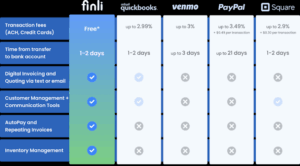
Most late payments result from preventable process failures. You invoice late. You’re missing payment options. You don’t send reminders. You have no visibility into invoice status. Finli addresses every one of these issues.
Immediate invoicing happens automatically. For project work, you can send professional invoices the moment work completes. For recurring clients, Finli’s automated recurring invoices go out on your schedule without requiring action. Your clients receive consistent, professional invoices at predictable times.
Crystal-clear payment terms are built in. Finli’s invoices state payment terms explicitly and include multiple payment methods. Clients see exactly when payment is due and how to pay.
Payment friction disappears. Finli’s one-click payments let clients pay directly from the invoice email. No separate portals. No manual data entry. One tap, payment complete. This simplicity translates to faster payments.
Automated reminders work automatically. Finli sends reminders via email and SMS at strategic intervals: a few days before the due date, on the due date, and at intervals past due. Your clients stay informed without you having to manually follow up.
Real-time visibility shows you exactly which invoices are outstanding, when clients view them, and when payments process. You know immediately when a payment fails so you can help resolve it before it becomes a problem.
For recurring clients, Finli’s recurring billing eliminates manual invoicing entirely. Payments process automatically on a schedule you set. Your cash flow becomes predictable because payments arrive reliably without requiring client action each month.
Takeaways
Late payments are rarely due to client malice. They usually result from preventable process failures on your end. Invoicing late, unclear payment terms, payment friction, missing reminders, and poor visibility all contribute to delays.
This week, audit your current invoicing process. How long does it take from completing work to sending an invoice? What payment options do you offer? Do you send reminders, and how often? What visibility do you have into invoice status? These questions reveal where your friction lives.
Then implement changes that eliminate friction. Send invoices immediately. Make payment terms crystal clear. Offer multiple payment methods. Set up automated reminders. Track invoice status in real-time.
The businesses that maintain healthy cash flow aren’t the ones with the best clients. They’re the ones with the best systems. When your invoicing and payment process removes friction instead of creating it, late payments become the exception instead of the norm.
Get started at finli.com or reach out to support@finli.com if you have questions.