
A contractor starts a business and searches for a banking solution. They find Mercury. Within 15 minutes, they have a business checking account, integrated invoicing, and a clean dashboard that shows their cash position in real time. No branch visit. No paperwork appointment. No two-week wait.
This is the experience that neobanks like Mercury, Relay, and Novo have built for small businesses, and it’s capturing a growing share of early-stage business relationships. Digital-only banks saw 37% year-over-year growth in Gen Z users in 2025. These platforms aren’t winning because they offer better interest rates or deeper lending relationships. They’re winning because they bundle the checking account with the operational tools that businesses need from day one, and they make the whole experience feel effortless.
For community banks and credit unions, this presents a real competitive challenge. But the response isn’t to become a neobank. It’s to combine the things neobanks can’t offer, local relationships, lending expertise, trust, and community knowledge, with the digital and operational capabilities that business owners now expect as standard.
(Source: CoinLaw Banking Preferences Statistics 2026)
What Neobanks Get Right
Understanding what makes neobanks attractive helps clarify where community institutions need to evolve and where they already have the advantage.
Neobanks solve the first problem immediately. When a business owner signs up, they don’t get a checking account and a promise that more tools are coming. They get invoicing, payments, and cash flow visibility from the start. The operational relationship and the banking relationship begin at the same moment. There’s no gap where the business goes looking for external tools.
They design for how business owners actually work. Mobile-first interfaces, clean dashboards, real-time data, and minimal friction. 92% of Gen Z prefer mobile apps over branch visits, and 95% of millennial-led businesses bank online. Neobanks built their entire experience around this reality rather than adapting a legacy system to accommodate it.
They make onboarding feel like a product experience, not a compliance process. Opening an account takes minutes, not days. The business owner starts using tools immediately rather than waiting for approvals. This speed creates a strong first impression that sets the tone for the entire relationship.
(Source: CoinLaw Banking Preferences Statistics 2026)
What Neobanks Can’t Offer
Despite these strengths, neobanks have significant limitations that community institutions can exploit.
They can’t lend the way community banks can. Most neobanks offer limited or no lending products. When a business needs a line of credit, equipment financing, or an SBA loan, they need a relationship with an institution that understands their business and can make nuanced credit decisions. This is the core competency of community banking, and no amount of digital polish can replace it.
They don’t know the local market. A community bank in a college town understands the property management landscape. A credit union in a growing suburb knows the construction cycle. This local knowledge enables more relevant conversations, better risk assessment, and a kind of partnership that a digital-only platform operating from a national office can’t replicate. 32% of lower-revenue small businesses favor community institutions specifically for this personalized, local approach.
They can’t build trust the same way. 47% of small business clients cite dedicated relationship manager support as a top criterion for choosing their primary bank. Neobanks offer chatbots and support tickets. Community institutions offer a person who knows your name, understands your business, and can make things happen with a phone call. That human element matters deeply to business owners, especially when something goes wrong or when they need guidance on a complex decision.
(Source: McKinsey Banking Matters,PYMNTS Intelligence SMB Growth Monitor)
The Winning Combination
The community institutions best positioned to compete with neobanks are the ones that pair their existing strengths with the operational capabilities that neobanks have popularized. 55% of millennial-run small businesses say they’d prefer to bank with a community institution if it offered similar digital capabilities to a large bank. The preference is already there. What’s been missing is the operational toolset.
(Source: Datos Insights / Apiture 2025 Millennial Small Business Survey
This combination is genuinely difficult for competitors to replicate. A neobank can’t easily add local lending expertise and community relationships. A megabank can’t easily deliver the personalized attention that community institutions provide. But a community bank or credit union that offers integrated invoicing, payment collection, customer management, and cash flow visibility alongside relationship banking and local lending creates a value proposition that neither competitor can match.
The key is making sure the operational tools are available from the first interaction, not as an afterthought six months later. When a business owner opens an account at your institution and immediately has access to invoicing, payments, and customer management, you’ve matched the neobank onboarding experience while offering everything they can’t: a lending partner, a local advisor, and a relationship that grows over time.
This matters for retention as much as acquisition. 75% of small businesses currently go outside their financial institution to meet at least one financial need. Many of those businesses are your existing customers who adopted external tools because your institution didn’t offer them at the time. Providing operational capabilities now stops the drift toward neobanks and external platforms by giving your current customers a reason to consolidate their activity back under your roof.
(Source: Datos Insights 2025 Matrix Report)
The community advantage also extends through referrals. Business owners in the same local market face the same challenges. When a contractor tells another contractor that their community bank offers invoicing, payment collection, and customer management alongside real lending relationships, that recommendation carries weight a neobank’s marketing can’t match. Operational tools give your customers something specific and valuable to talk about within the business communities where you already have presence.
How Finli Levels the Playing Field
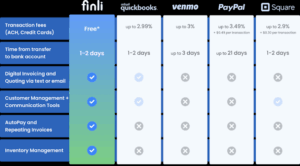
Finli provides community banks and credit unions with the operational platform that closes the capability gap with neobanks. Integrated invoicing, payment processing with 0% ACH fees, AutoPay, automated reminders, customer management, and real-time cash flow visibility, all under your brand, delivered through a modern interface that matches the experience younger business owners expect.
The 0% ACH processing directly competes with neobank pricing while keeping deposits within your institution. The white-label approach means every interaction reinforces your brand, not a third-party platform. And unlike neobanks, your institution pairs these tools with real lending relationships, local market knowledge, and dedicated relationship managers.
Finli launches in under 24 hours with no developer resources required. The “Try Before You Integrate” approach lets you start competing immediately, with prebuilt Q2 and Jack Henry integrations available as you scale. You don’t need to become a neobank. You need to offer what they offer plus everything they can’t.
Takeaways
Neobanks are winning early-stage business relationships by bundling checking with operational tools and delivering a frictionless digital experience. Community banks and credit unions don’t need to replicate that model. They need to match the operational capabilities while leveraging the advantages neobanks fundamentally cannot offer: local lending, personal relationships, and community knowledge.
55% of millennial-run businesses already prefer community institutions if the digital experience is comparable. The demand is there. Closing the capability gap with operational tools transforms community banking’s existing strengths into a competitive position that neither neobanks nor megabanks can match.
Finli enables community institutions to compete on digital experience without sacrificing what makes them valuable. The result is the best of both worlds: neobank-level operational tools with community bank-level relationships.