
The generation of business owners entering the market right now has never known a world without instant payments, same-day delivery, and apps that solve problems in minutes. When they start a business, they don’t walk into a branch and ask what’s available. They search for the tool that solves their first operational problem, and they expect it to work immediately. If a financial institution isn’t part of that initial search, it may never get the chance to compete for the relationship.
This shift is already visible in the numbers. 44% of millennial and Gen Z-led businesses are considering switching financial institutions within two years. 55% of millennial-run small businesses say they’d prefer to bank with a community institution if it offered similar digital capabilities to a large bank. The demand for local, relationship-driven banking hasn’t disappeared. But the definition of what qualifies as a capable banking partner has changed. Digital tools, operational support, and speed are now baseline expectations, not differentiators.
(Source: Datos Insights / Apiture 2025 Millennial Small Business Survey)
How Their Expectations Are Different
Younger business owners evaluate their financial institution the same way they evaluate every other tool in their lives: does it solve a problem, does it work on my phone, and does it integrate with everything else I use?
95% of millennial-led small businesses bank online, and over 70% rely on mobile banking as their primary channel. For Gen Z, those numbers are even higher, with 92% preferring mobile apps over branch visits. This isn’t a preference for digital as a nice-to-have. It’s an expectation that the entire relationship can be managed from their phone. When a business owner can set up a Stripe account, send their first invoice, and collect a payment in 15 minutes from their couch, a two-week merchant account approval process feels like it belongs to a different era.
But digital capability alone isn’t enough. Younger business owners also want their tools consolidated. 82% of small business owners say consolidating their digital tools is a priority, and 63% say they’re overwhelmed by the number of platforms needed to run their business. They don’t want more apps. They want fewer apps that do more. A financial institution that offers checking, invoicing, payment collection, and customer management in one place matches how this generation thinks about tools: integrated, not fragmented.
87% of small business owners now view digital tools as very important or essential, a 15-percentage-point jump from the previous year. This shift is accelerating, not leveling off.
(Source: U.S. Bank Small Business Perspective Survey 2025, CoinLaw Millennial vs. Gen Z Banking Preferences 2026)
They Don’t Separate Banking from Operations
For older generations of business owners, banking and daily operations were distinct categories. You went to the bank for financial products. You used separate tools for invoicing, payments, and customer management. These were different parts of the business that lived in different places.
Younger business owners don’t draw that line. When they evaluate a financial partner, they’re asking whether that partner can help them run their business, not just hold their money. The platforms that win their loyalty are the ones that combine financial services with operational tools in a single experience. Mercury, Relay, and Novo have captured early-stage businesses precisely because they bundle checking with the operational capabilities that business owners need from day one.
This is why 50% of millennial-run businesses say they would switch institutions for better payment options alone. It’s not that they care about payment processing in isolation. It’s that payment processing is part of how they run their business, and they expect their bank to be part of that workflow. When the bank is separate from where business happens, the bank becomes dispensable.
(Source: Datos Insights / Apiture 2025 Millennial Small Business Survey)
What This Means for Community Banks and Credit Unions
The good news for community institutions is that younger business owners haven’t rejected local banking. They’ve rejected limited banking. More than half of millennial-run businesses would prefer a community institution if it offered comparable digital capabilities. The trust, local knowledge, and relationship depth that community banks and credit unions provide are still valued. They’re just no longer sufficient on their own.
This creates a clear path forward. Community institutions that pair their existing strengths, local presence, personal relationships, lending flexibility, with the digital and operational tools younger business owners expect will compete effectively against both national banks and neobanks. The combination of relationship banking and operational utility is something neither a neobank nor a megabank can easily replicate.
The risk of waiting is real. Nearly 40% of Gen Z business owners launched their ventures before age 22. 65% of young adults are running side businesses alongside their main jobs. These businesses are forming their operational habits right now, choosing the tools they’ll rely on for years. Every month a community institution operates without operational capabilities is a month where this generation builds its workflows around platforms that aren’t yours.
Reaching Them Where They Start
Traditional small business marketing assumes business owners will seek out a bank when they’re ready. Younger business owners don’t follow that path. They search for a way to get paid, find a tool that works, and figure out the banking piece later. The institution that’s part of the first search captures the relationship. The one that waits for the business owner to come to them often never gets the chance.
This means leading with operational value in your outreach. “Send invoices and get paid faster” resonates with a 25-year-old starting a consulting practice. “Comprehensive SMB cash management solutions” does not. Meet them with the language they use, on the channels they’re already on, solving the problem they’re trying to solve today.
How Finli Positions Your Institution for the Next Generation
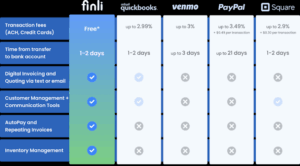
Finli provides financial institutions with the operational platform that meets younger business owners’ expectations. Integrated invoicing, payment processing with 0% ACH fees, AutoPay, automated reminders, customer management, and real-time cash flow visibility, all under your brand, delivered through a mobile-friendly platform that works the way this generation expects tools to work.
The platform consolidates the fragmented stack that 63% of business owners say overwhelms them. Instead of juggling separate invoicing, payment, and CRM tools, the business owner gets everything in one place through their bank. This positions your institution as the integrated financial partner that younger business owners are looking for, combining the operational utility of a neobank with the trust and relationship depth of a community institution.
Finli integrates with Q2 and Jack Henry, requires no developer resources, and launches in under 24 hours.
Takeaways
The next generation of business owners evaluates financial institutions by a different standard than previous generations. Digital capability, operational tools, mobile-first design, and speed are baseline expectations. 44% of millennial and Gen Z-led businesses are already considering switching institutions, and 55% would prefer a community bank if it offered comparable digital capabilities.
These business owners don’t separate banking from operations. They want a single platform that handles checking, invoicing, payments, and customer management together. The institutions that meet this expectation will capture a generation of business owners who are forming their financial habits right now. The ones that wait will find those habits increasingly difficult to change.
Finli enables community banks and credit unions to meet this generation where they are, providing the operational platform that combines the digital experience they expect with the relationship banking they value. The next generation of business owners is choosing their financial partners now. Make sure your institution is in the conversation.