
Every small business you want to serve already has a bank. They have a checking account, probably a debit card, maybe a credit line. They’re not sitting around waiting for a new institution to come along. The question isn’t how to reach businesses that don’t have banking relationships. It’s how to give businesses that already bank somewhere else a reason to move.
About 15% of small businesses changed banks in the past 12 months, and 35% say they’re open to the possibility. That’s a significant pool of businesses actively or passively considering a switch. But the institutions winning these relationships aren’t winning on rate or branch proximity. They’re winning by solving problems that the current bank doesn’t even know exist.
(Source: Greenwich Market Pulse Report)
Why Businesses Stay with Banks That Underserve Them
Most small business owners chose their bank for practical reasons: it was nearby, it was where they already had a personal account, or it was the first one that approved their application. The relationship started as a convenience choice, not a strategic one. And for many businesses, it stays that way because switching feels like more trouble than it’s worth.
The biggest reason business owners stay isn’t satisfaction. It’s inertia. They’ve set up direct deposits, linked payment processors, configured automatic transfers, and built workflows around their current account. Moving means updating every vendor, redirecting every payment, and managing a transition period where funds could end up in the wrong place. For a busy business owner, tolerating a mediocre banking relationship feels easier than disrupting operations to find a better one.
This means the barrier to acquisition isn’t loyalty. It’s friction. Business owners will switch when the value of moving clearly outweighs the hassle of the transition. A slightly better rate doesn’t clear that bar. A slightly friendlier banker doesn’t either. What clears the bar is solving a problem that the business owner deals with every day and that their current bank doesn’t address.
What Actually Motivates a Switch
When small businesses do switch, the reasons are revealing. Lower fees and personalized customer service are highly valued, but the businesses most likely to move are the ones whose operational needs have outgrown what their current institution provides.
A contractor whose business has doubled in size is now processing significantly more transactions, managing more clients, and dealing with more complex cash flow timing. Their bank still offers the same checking account they opened three years ago. No invoicing tools, no payment collection, no customer management. The contractor isn’t angry. They’re just running their business on platforms that have nothing to do with their bank, and the bank has become a place where money sits rather than where business happens.
This is the acquisition opening. The businesses most ready to switch aren’t the ones looking for lower fees. They’re the ones whose daily operations have outpaced their banking relationship. 75% of small businesses go outside their financial institution to meet at least one financial need. Every one of those businesses is a prospect for an institution that can consolidate those needs under one roof.
(Source: Datos Insights 2025 Matrix Report)
Leading with Operational Value, Not Products
The traditional approach to business acquisition is product-led: promote a competitive checking account, offer a signing bonus, advertise your loan rates. This approach targets the businesses shopping on price, which tend to be the least loyal clients. They came for a better deal and they’ll leave for the next one.
A more effective approach leads with operational value. Instead of asking “what rate can we offer?” ask “what problem can we solve?” When your pitch to a prospective business owner is “we can save you 14 hours a week on administrative work, help you get paid twice as fast, and give you real-time visibility into your cash flow,” you’re offering something their current bank can’t match by adjusting a fee schedule.
This changes who you attract. Businesses that switch for operational value tend to consolidate more of their financial relationship, engage more deeply with the platform, and stay longer. They’re not comparing you to their old bank on rate. They’re comparing the experience of running their business with your tools versus without them. That’s a much stronger competitive position.
Small businesses using comprehensive operational platforms through their financial institution typically generate 3.2x more revenue through expanded service utilization, higher deposit balances, increased fee income, and stronger loan relationships. These are the high-value clients you want to acquire, and operational value is what attracts them.
(Source: American Bankers Association Commercial Banking Survey)
The Community Advantage
Community banks and credit unions have a natural advantage in small business acquisition that national institutions struggle to replicate: local relationships. 32% of lower-revenue small businesses favor community banks and credit unions, citing personalized service and local presence as major factors.
Business owners talk to each other locally. They share recommendations at networking events, in trade groups, and through professional associations. When one contractor tells another, “my bank set me up with invoicing and payment tools that completely changed how I run the back office,” that recommendation carries weight because it’s specific, credible, and coming from someone in the same market.
This is why operational value and community presence work together as an acquisition strategy. The community relationship gives you access and trust. The operational tools give you something worth recommending. Neither works as well alone. A community bank without modern tools loses prospects to fintechs. An operational platform without local relationships struggles to build the trust that small business owners require before switching.
(Source: PYMNTS Intelligence SMB Growth Monitor)
Making the Switch Easy
Even when a business owner sees clear value in moving, the perceived friction of switching can stall the decision. The institutions that convert prospects into clients make the transition feel manageable.
Offer to run in parallel. Let the business set up invoicing and payment tools on your platform while their old checking account is still active. Once they see payments flowing through your system and experience the operational benefits firsthand, moving the primary account becomes a natural next step rather than a leap of faith.
Solve the first problem fast. If a prospect mentions they’re spending hours chasing payments, set them up with automated reminders and digital payment links before the conversation about account transfers even starts. Demonstrating value early builds confidence that the switch is worth the effort.
Use data from the platform to make the case. Once a business starts processing payments through your tools, you can show them exactly how much faster they’re getting paid, how much time they’re saving, and how their cash flow has improved. These are concrete numbers that justify the remaining transition effort.
How Finli Powers Your Acquisition Strategy
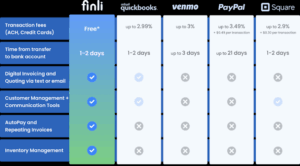
Finli provides financial institutions with the operational platform that gives prospective business clients a reason to switch. When your institution can offer integrated invoicing, payment processing with 0% ACH fees, AutoPay, automated reminders, customer management, and real-time cash flow visibility, you’re presenting a value proposition that checking accounts and rate sheets alone cannot deliver.
The 0% ACH processing is especially relevant for acquisition. Business owners currently paying 2.6-3.5% in transaction fees to external processors see immediate, tangible savings. For a business processing $30,000 monthly, that’s $780-1,050 per month in fees that disappear. That savings alone can justify the effort of switching, and it’s just the starting point of a deeper operational relationship.
Finli’s “Try Before You Integrate” approach supports the parallel onboarding strategy. Prospects can start using operational tools under your brand before formally moving their primary account. As they experience the value, the full transition happens naturally. Finli integrates with Q2 and Jack Henry and requires no developer resources to deploy.
Takeaways
Winning small business clients who already bank somewhere else requires offering something their current institution doesn’t: operational tools that solve daily problems. Rate competition and signing bonuses attract price-sensitive clients who leave at the next offer. Operational value attracts businesses that consolidate their relationship, engage deeply, and stay.
About 15% of small businesses switched banks last year, and 35% are open to moving. The businesses most likely to switch are those whose daily operations have outgrown what their current bank provides. They’re running invoicing, payments, and customer management through external platforms because their bank never offered an alternative.
Finli enables financial institutions to lead with the operational value that motivates these switches. By offering comprehensive business tools under your brand, you give prospects a reason to move that goes far beyond rates and fees. The institutions winning the most new small business relationships aren’t offering the cheapest accounts. They’re offering the most useful ones.