You can be profitable and still run out of money. It sounds contradictory, but it happens to small businesses all the time. You finish a $5,000 job and send the invoice. Your income statement looks fine. But the client is on Net 30 terms, and in the meantime, you need to cover $1,800 in payroll this Friday, $1,200 in rent next week, and $600 in materials for the next project.
That’s the gap between profit and cash flow. Profit is what your books say you earned. Cash flow is what actually moves through your bank account, and when. Those two things can be weeks apart, and that gap is where most financial stress lives.
According to the 2025 Small Business Credit Survey, 51% of small businesses struggle with uneven cash flow, and 70% hold less than four months of cash reserves. The businesses that avoid cash crunches aren’t necessarily earning more. They can just see problems coming far enough in advance to do something about them.
That visibility comes from one practice: cash flow forecasting.
(Source: Federal Reserve 2025 Small Business Credit Survey)
What Cash Flow Forecasting Actually Does
A cash flow forecast projects the money coming into and going out of your business over a set period. Unlike your income statement, which tracks what you’ve earned on paper, a forecast tracks when cash actually moves. It answers the question that matters most on a day-to-day basis: will I have enough money in my account to cover what’s due this week?
When you forecast, you start with your current bank balance, map out expected inflows (customer payments, deposits, recurring revenue) and outflows (rent, payroll, supplies, loan payments, taxes) for each period, and calculate your running cash position over time.
The result is a clear picture of where your cash stands now and where it’s headed. Weeks that look comfortable become opportunities to build reserves or invest. Weeks that look tight become planning targets instead of emergencies.
Why Forecasting Changes How You Run Your Business
Without a forecast, you’re managing cash reactively. You check the bank balance, decide whether you can afford something, and hope a payment arrives before the next big bill clears. That cycle keeps you in constant low-grade stress.
With a forecast, you can see a tight week coming and speed up an invoice, delay a non-essential expense, or have an honest conversation with a vendor about timing. You can spot patterns you’d otherwise miss, like the fact that you hit a cash dip every month around the 20th because your biggest recurring client pays on the 28th but rent and payroll both clear on the 15th.
It also reveals where cash gets stuck in your business. Service businesses often find that long payment terms are the real problem. Contractors discover that fronting materials and labor for weeks before invoicing creates persistent strain. These patterns are invisible when you’re just checking your balance. A forecast makes them obvious so you can address them directly.
Why the 13-Week Forecast Works Best for Small Businesses
You can forecast over any time frame, but financial professionals widely consider the 13-week rolling forecast the gold standard for short-term cash planning. Thirteen weeks equals one quarter, and it hits the sweet spot between accuracy and foresight.
It’s short enough that your data is concrete. You know which invoices are outstanding, which bills are due, and what your recurring expenses look like. But it’s long enough to reveal seasonal dips, upcoming tax payments, and cash gaps before they arrive.
Monthly forecasts, by comparison, can hide critical timing issues. Your books might show positive cash flow for the month, but within that same month you could face a mid-month crunch that a monthly view completely misses. The weekly granularity of a 13-week forecast catches those gaps.
(Source: GTreasury)
How to Build Your 13-Week Forecast
You don’t need accounting software or a finance background. A basic spreadsheet works perfectly.
Start with your current cash position. Log into every business account and add up your balances. That total is your opening number for Week 1.
Map out your expected inflows. For each week, list every payment you genuinely expect to receive. Use actual invoice due dates, not the date you sent the invoice. For pipeline deals that haven’t closed, discount them to about 70% of face value. If you’re expecting $8,000 in new work, enter $5,600. This keeps your forecast realistic.
List everything going out. Rent, payroll, loan payments, and subscriptions are the easy ones. The expenses that catch people off guard are the irregular ones: quarterly estimated tax payments, annual insurance renewals, software licenses. Don’t forget the employer portion of payroll taxes, which often clears a few days after payroll runs.
Calculate your weekly position. For each week, subtract total outflows from total inflows. Track your running balance: each week’s closing balance becomes the next week’s opening balance. Walk this through all 13 weeks.
A closing balance of $6,000 in Week 3 tells you things are stable. A closing balance of -$800 in Week 8 is a warning. But it’s a warning you received six weeks early, which gives you time to act.
Update it every week. Set aside 15 minutes at the same time each week. Replace projections with what actually happened and add a new week at the end. The habit of maintaining it is what makes this tool genuinely useful.
How to Act on What You Find
If you see a gap coming, speed up your inflows. Follow up on overdue invoices now. Invoice at the current milestone rather than waiting for completion. Encourage recurring customers to set up automatic payments. On the outflow side, pay bills on the due date rather than early, and talk to vendors about extending terms if needed.
If you’re consistently tight, look at structural issues. Are your payment terms too generous? Many small businesses default to Net 30 when they could require payment within 15 days. Are you invoicing the same day you finish work, or letting days slip before sending the bill?
If you have surplus weeks, build your cash reserve. Start by transferring 5% of every incoming payment to a separate savings account. For a business bringing in $6,000 per month, that’s $300 per month, or $3,600 in a year. That’s real breathing room when a slow month hits.
How Finli Supports Better Cash Flow Visibility
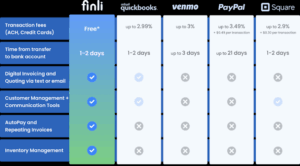
The accuracy of your forecast depends on how well you can track what’s happening with your invoices and payments. Finli gives you that visibility in real time.
When you send an invoice through Finli, you can see exactly when your customer opens it, whether payment is processing, or if a payment method failed. That means you’re updating your forecast with actual data each week, not guesses about whether a client plans to pay.
Automated payment reminders keep collections moving without you spending time on follow-up emails. Finli sends reminders at the right intervals before and after due dates, so invoices don’t age silently while you’re focused on running your business.
For recurring customers, Finli’s Autopay features turn unpredictable revenue into reliable, automatic inflows. When even a portion of your revenue is on autopay, your forecast becomes significantly more accurate. And with QuickBooks integration syncing customers, invoices, and payments automatically, your data is already organized when you sit down for your weekly update.
Every feature comes included at $39/month with 0% ACH fees, so the tools that improve your cash flow visibility don’t eat into the margins you’re working to protect.
Takeaways
Cash flow problems build gradually through small signals: paying bills on the last possible day, shuffling money between accounts, relying on a credit card to cover operating expenses. A cash flow forecast makes those signals visible before they become emergencies. The 13-week rolling approach gives you the right balance of accuracy and foresight to plan with confidence.
You don’t need anything fancy to start. A spreadsheet and 15 minutes a week are enough. The businesses that manage cash flow well aren’t doing anything complicated. They’re simply looking far enough ahead to make decisions with options instead of making decisions under pressure.
Ready to get better visibility into your cash flow? Get started at finli.com or reach out to our team at support@finli.com.