A client asks if they can just “Venmo you” for a project instead of paying an invoice. It feels easy in the moment, no invoice to create, no payment processor to set up. But peer-to-peer apps like Venmo and PayPal weren’t built to run a business on, and the gaps show up the moment your business grows past a handful of informal transactions.
If you’re currently collecting business payments through a personal payment app, it’s worth understanding exactly what you’re giving up, and what it’s actually costing you.
Where Venmo and PayPal Fall Short for Business
Both apps were designed for individuals splitting costs or sending money to people they know, not for running invoicing, tracking customer payment history, or managing a client base. That shows up in a few consistent ways.
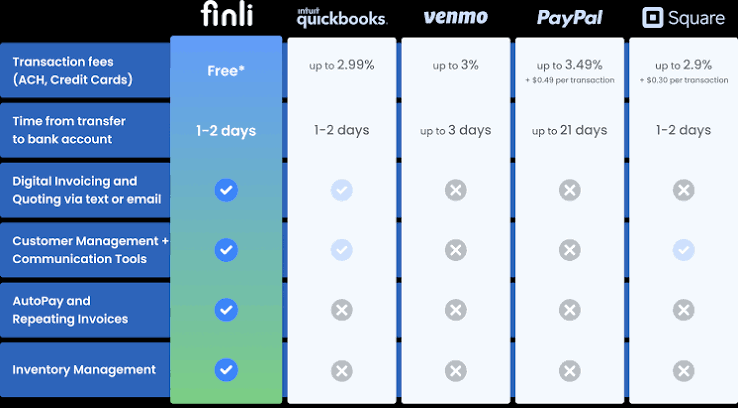
Neither Venmo nor PayPal offers digital invoicing or quoting built into the platform. You can’t send a professional invoice with itemized services, due dates, and payment terms. You’re sending a payment request at best, which looks and feels informal, and doesn’t give your client the documentation they need for their own records.
Neither offers real customer management tools. There’s no way to see a client’s full payment history, add notes about a project, store contracts or documents, or track who owes you what across multiple invoices. Every transaction exists on its own, disconnected from the broader relationship.
Neither supports recurring invoices or autopay for business relationships. If you bill the same client the same amount every month, you’re manually requesting payment every single time instead of setting it up once and letting it run automatically.
The Fee Difference Is Real
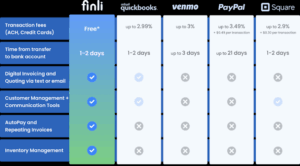
Venmo doesn’t charge a fee for standard bank transfers, similar to Finli’s 0% ACH fees. But transfers to your bank account can take up to three days, compared to one to two days with Finli.
PayPal is a different story. Business transactions through PayPal typically carry a fee of around 2.99%, and transfers to your bank account can take up to 21 days depending on the transfer method. On a $5,000 project, that’s roughly $150 lost to fees alone, and up to three weeks before the money is actually usable. Finli charges 0% ACH fees, with the option to pass credit card processing costs on to the customer instead of absorbing them yourself.
Over a year of regular business payments, that fee difference adds up to real money, on top of the time cost of not having invoicing, customer tracking, or automated reminders built in.
Why “It’s Free and Everyone Has It” Isn’t the Full Picture
The appeal of Venmo and PayPal is obvious. Clients already have the apps installed. There’s no learning curve. It feels like the path of least resistance.
But that convenience comes at the cost of looking unprofessional, losing visibility into your own receivables, and doing manually what a business platform would automate. A client paying through Venmo isn’t getting an invoice they can reference later. You’re not getting a record you can pull up when you need to know who’s paid and who hasn’t. And you’re doing that reconciliation work by hand, checking your Venmo or PayPal balance against a mental list of who owes what.
For a truly informal, one-time transaction, that might be fine. For an ongoing business relationship with recurring payments, project invoices, and multiple clients, it becomes a liability. You’re essentially running your business’s financial records through an app that wasn’t designed to keep them.
What a Business-Built Platform Adds
A platform built specifically for small business invoicing and payments closes every one of these gaps. You can send professional invoices with clear line items and due dates. You can see a complete history of every customer, every invoice, and every payment in one place. Recurring clients can be set up on autopay so you’re never manually requesting the same payment twice. Automated reminders follow up on overdue invoices without you having to track it yourself.
The fee structure matters too. With 0% ACH fees and the option to pass credit card processing costs to the customer, you keep more of what you earn compared to a platform that takes a percentage off every transaction.
When Venmo or PayPal Might Still Make Sense
There are situations where a peer-to-peer app is genuinely fine. A one-time payment from a friend, a very small transaction with someone you already know well, a reimbursement rather than a business payment. These aren’t the situations where invoicing and customer tracking matter.
The distinction is whether you’re running an ongoing business relationship or handling a single informal exchange. If you’re sending invoices, tracking multiple clients, or collecting recurring payments, you’ve outgrown what a personal payment app was built to do.
Takeaways
Venmo and PayPal work well for what they were designed for: quick, informal, personal transfers. They weren’t built for invoicing, customer management, or recurring business billing, and using them for that purpose means doing manually what a business platform automates, while potentially losing money to fees along the way.
This week, look at how you’re currently collecting payments from clients. If you’re relying on a personal payment app for anything beyond a one-off transaction, calculate what the missing invoicing, tracking, and automation is actually costing you in time and lost visibility.
Get started at finli.com or reach out to support@finli.com if you have questions.