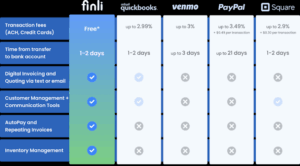

There are roughly 30 million non-employer businesses in the United States: sole proprietors, freelancers, and one-person operations that make up the vast majority of small businesses by count. Most of them don’t have a business bank account. Many run revenue through their personal checking account, accept payments through Venmo or PayPal, and track expenses in a notebook or not at all. They represent an enormous pool of potential small business customers, and they’re almost invisible to traditional banking outreach.
For financial institutions, this segment presents a specific challenge. These businesses have real operational needs: they send invoices, collect payments, manage customers, and struggle with cash flow just like larger small businesses. But they don’t think of themselves as needing a banking relationship, and traditional SMB marketing doesn’t reach them. They’re not attending chamber of commerce events. They’re not searching for “business checking account.” They’re googling “how to send an invoice” or “easiest way to get paid.” The institutions that figure out how to reach these businesses early, before they’ve built their operations entirely around external platforms, will capture a segment that grows into increasingly valuable relationships over time.
(Source: U.S. Census Bureau Nonemployer Statistics 2025)
Why Traditional Outreach Misses Them
Most small business banking marketing is designed for businesses that already see themselves as businesses. It promotes checking accounts, credit lines, and merchant processing to owners who have an LLC, a tax ID, and a clear sense that they need business banking products. This approach works for the 5.5 million employer firms in the country. It largely misses the other 30 million.
Early-stage sole proprietors and freelancers don’t respond to this messaging because they don’t identify with it. A contractor who just started picking up side jobs doesn’t think of themselves as a “small business owner” who needs a “business banking relationship.” They think of themselves as someone who does contracting work and needs to figure out how to get paid. A consultant who left a corporate job to go independent doesn’t start by looking for a bank. They start by looking for clients and then a way to invoice them.
The language gap matters. When a financial institution promotes “comprehensive SMB solutions” or “business cash management,” it’s speaking to an audience that already understands these concepts. The businesses that need the most help with invoicing, payment collection, and cash flow management are the ones least likely to recognize those terms as relevant to them.
44% of small businesses don’t even apply for loans because they assume they won’t qualify. This same psychology applies more broadly to banking services. Many early-stage business owners assume that business banking products aren’t for them yet, that they need to be bigger, more established, or more formalized before a bank would want to work with them.
(Source: Canopy Small Business Lending Statistics 2025)
Where They Go Instead
While these businesses avoid traditional banking outreach, they’re actively adopting operational tools. 84% of small businesses in the U.S. now use at least one fintech service. For early-stage businesses, the adoption often starts with the simplest version of “how do I get paid?”
A freelance consultant finds Stripe and starts accepting payments through a link on their website. A contractor downloads Square and begins processing card payments on job sites. A property manager sets up PayPal to collect rent from tenants who don’t want to write checks. Each of these decisions is small, practical, and completely disconnected from any banking relationship.
The fintech platforms that capture these businesses aren’t winning through sophisticated marketing. They’re winning by showing up in search results when someone types “send an invoice for free” or “accept credit card payment.” They’re solving the immediate operational problem without requiring the business owner to think about banking at all. And once these platforms are established in the daily workflow, they expand: Square offers banking, Stripe offers treasury services, PayPal offers working capital. The early-stage business that started with a simple payment link gradually builds an entire financial relationship with a platform that isn’t a bank.
By the time these businesses grow to the point where they’d benefit from a traditional banking relationship, they’ve already built their operations on platforms that are difficult to displace. 70% of businesses without a business bank account that applied for financing in the past two years were denied. The lack of formal banking history creates a cycle: they can’t get financing because they don’t have a business account, and they don’t open a business account because no one showed them why it mattered when they were just starting out.
(Source: Nav Business Banking Survey 2025, CoinLaw Research on SME Fintech Usage)
How to Reach Them Where They Are
The institutions that successfully reach early-stage businesses do so by meeting them at the operational problem, not at the banking product. This requires a different acquisition approach than traditional SMB marketing.
Lead with tools, not accounts. When the entry point is an invoicing tool or a payment collection platform rather than a checking account application, you meet business owners where they already are: trying to figure out how to get paid. A contractor searching for a way to send a professional invoice is much more likely to engage with a platform that solves that problem immediately than with an ad for a business checking account.
Make formalization feel like an upgrade, not a barrier. Many early-stage business owners avoid opening a business bank account because the process feels heavy: paperwork, minimum balances, documentation requirements. Institutions that lower this barrier, that let someone start using operational tools immediately and transition to a full banking relationship as the business grows, capture clients during the window when habits are still forming.
Speak their language. “Send invoices and get paid faster” resonates with a freelancer. “Comprehensive SMB cash management solutions” does not. The messaging that reaches early-stage businesses describes outcomes they care about in terms they use, not banking terminology they’ve never encountered.
Use existing clients as the pathway. Many of the 30 million nonemployer businesses are connected to your existing small business customers. They’re the subcontractors, freelancers, and vendors in your clients’ networks. When your platform facilitates payments between your clients and their vendors, you create a natural introduction to the vendor’s business. That subcontractor who receives a payment through your client’s platform has just experienced your institution’s tools firsthand.
How Finli Creates the Entry Point
Finli provides financial institutions with the operational platform that serves as the entry point for early-stage businesses. When the first interaction with your institution is a professional invoicing tool, a payment collection system with 0% ACH fees, and a customer management platform rather than a checking account application, you reach business owners at the moment they’re solving their first operational problem.
The platform meets early-stage businesses where they are: trying to get paid, trying to look professional, trying to spend less time on administrative work. As these businesses grow, the operational tools grow with them, adding AutoPay, automated reminders, cash flow visibility, and deeper banking integration through your institution. The relationship expands naturally from a simple operational tool to a full banking partnership.
Finli’s white-label approach means every interaction builds your brand, not a third-party fintech’s. The contractor who starts with your invoicing tool and grows into a full business banking relationship has been building familiarity with your institution from day one.
Finli integrates with Q2 and Jack Henry, requires no developer resources, and launches in under 24 hours.
Takeaways
The 30 million nonemployer businesses in the United States represent a massive opportunity for financial institutions willing to rethink how they reach early-stage business owners. These businesses have real operational needs, but traditional SMB marketing doesn’t connect because they don’t yet see themselves as the target audience for banking products.
The institutions winning these relationships are the ones that lead with operational tools rather than banking products, meeting business owners at the “how do I get paid?” moment rather than the “I need a business checking account” moment. This approach captures businesses during the window when habits are forming, before fintech platforms have established themselves as the default financial partner.
Finli enables financial institutions to create this entry point by providing the operational platform that solves the first problem early-stage businesses face. The businesses that need you most will become your most valuable customers over time. The challenge is reaching them before someone else does.