You finished the job, sent the invoice, and got paid. But after covering your costs, paying yourself, and setting a little aside, you were left wondering where it all went.
The work was good. The client was happy. And yet the numbers didn’t add up the way they should.
For a lot of small business owners, that feeling is familiar. Not because the business isn’t working, but because the pricing was never built on solid ground to begin with. Most service businesses set their rates by glancing at competitors, picking a number that felt reasonable, and moving on. The problem is that “reasonable” usually means too low. And once those prices are set, they tend to stay put even as costs climb, skills sharpen, and the value you deliver grows.
The fix isn’t working more hours or landing bigger clients. It’s understanding what your services actually cost to deliver, what a healthy margin looks like, and how to charge accordingly. That’s what this guide walks you through.
Start with Your Real Costs
Most owners dramatically underestimate what it costs to run their business. They account for direct costs like labor and materials, but overlook all the overhead that quietly eats into every dollar of revenue.
Your true costs include both direct and indirect expenses. Direct costs are things like the time you spend delivering work, supplies, or subcontractors. Indirect costs, also called overhead, include rent or home office expenses, software subscriptions, insurance, marketing, accounting fees, and administrative time.
To price correctly, add up all your annual overhead costs and divide that number by the hours you actually bill to clients in a year. That gives you your overhead cost per billable hour before you’ve earned a single dollar of profit.
For example, if your annual overhead is $24,000 and you bill 1,000 hours per year, your overhead cost per billable hour is $24. Add that to your direct costs for each job and you have your cost floor. Anything below that number and you’re losing money.
Factor in Your Time Correctly
Time is the most undervalued cost in most service businesses. When you’re the owner, the hours you spend on a project include more than the hands-on work. You’re also fielding client emails, attending discovery calls, revising proposals, managing follow-ups, and handling admin.
Calculate your effective hourly rate on recent projects by taking the total revenue and dividing it by the total hours invested, including every email, meeting, and revision. Most business owners are surprised by how low that number actually is.
Your time has real value. If you could be doing something else with those hours, whether that’s taking on another client or stepping back from daily operations, that opportunity has a dollar amount attached to it. Build it into your pricing.
Understand What a Healthy Margin Looks Like
Profit isn’t what’s left over after expenses. It’s something you build into your prices on purpose. Service businesses typically target net profit margins of 15 to 20 percent because overhead is lower than in product-based businesses and there’s no inventory to carry. (Source: Bluevine https://www.bluevine.com/blog/what-is-a-good-profit-margin)
That margin is what lets you pay yourself properly, invest in growth, build a cash reserve, and absorb slow periods without panic.
The formula is straightforward: take your total costs for a job, add the profit margin you want to earn, and that’s your price. If a project costs you $800 in time and overhead and you want a 20 percent margin, your price should be at least $1,000.
Many owners skip this step entirely and set prices based on what feels acceptable to clients. The result is a business that stays busy but never gets ahead.
Common Pricing Mistakes to Avoid
Pricing based on competitors alone. Looking at what others charge can give you a general sense of the market, but it tells you nothing about whether those prices are actually profitable. You don’t know their cost structure, their margins, or whether they’re making money.
Never revisiting your prices. Costs increase every year, which means prices that made sense two years ago may no longer cover your overhead today. Build a pricing review into your calendar at least once a year.
Ignoring payment processing fees. Every time a client pays by credit card, a percentage leaves your pocket before you ever see it. Credit card processing typically runs 2.5 to 3.5 percent per transaction. On $70,000 in annual revenue, that’s $1,750 to $2,450 quietly disappearing every year. These fees belong in your cost calculations when you’re setting prices.
Scope creep without repricing. When a project expands beyond what was originally agreed, many owners absorb the extra work rather than adjust the invoice. This is a direct hit to profitability. Build scope boundaries into your agreements and charge when work goes beyond them.
How to Raise Prices Without Losing Clients
Raising prices feels risky, but research consistently shows that most businesses can increase rates with minimal client attrition. According to a widely cited Harvard Business Review study, a 1% increase in price translates to an 11.1% improvement in operating profit. Even a modest pricing adjustment has an outsized effect on the bottom line. (Source: Harvard Business Review https://hbr.org)
A few approaches that work well for service businesses:
- Raise rates for new clients first. This lets you test higher pricing without disrupting existing relationships. Once new clients accept the new rates without pushback, you have evidence the market supports them.
- Give existing clients advance notice. A short, professional message explaining that your rates are increasing on a specific date, with enough lead time for them to plan, tends to be well received. Most clients who value your work will stay.
- Tie increases to a tangible reason. Whether it’s the start of a new year, a new service offering, or expanded availability, framing a price increase as a natural part of your business evolution makes it easier for clients to accept.
How Payment Fees Are Quietly Cutting Your Margins
Even when your prices are right, the fees attached to how you collect payment can erode profitability in ways that are easy to overlook.
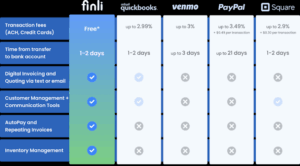
If most of your clients pay by credit card, a percentage of every invoice is going to your payment processor. It adds up fast. Encouraging clients to pay via ACH bank transfer instead can significantly reduce those costs. With Finli, ACH payments carry 0% fees, compared to the flat 3% rate for credit cards. For a business bringing in $75,000 a year, shifting even half of those payments to ACH saves over $1,000 annually in processing costs alone.
Finli also makes it easy to send professional invoices with built-in payment options, automated reminders, and real-time tracking so you always know where each payment stands. When pricing is dialed in and collection runs smoothly, the margin you built into your prices actually stays in your business.
Where to Start This Week
Pick your three highest-volume services and run the numbers. Calculate your true cost per project including overhead and your time at a fair rate. Compare that to what you’re currently charging and see where the gap is.
If your prices are covering costs but leaving little room for profit, you have a pricing problem that more clients won’t solve. The path forward is charging what the work actually costs to deliver, plus a margin that makes the business worth running.
Pricing isn’t about what feels comfortable. It’s about what makes your business sustainable.