
Your small business customers start every morning the same way. Before a contractor drives to a job site, before a consultant takes their first client call, before a property manager responds to a maintenance request, they sit down and try to figure out where their business stands. They check their bank balance, review outstanding invoices, chase late payments, and do the mental math on what’s coming in and going out. The tools they reach for during this first hour are the ones that define their primary financial relationship.
For most financial institutions, this is a missed opportunity. Your platform appears in that morning routine for about 30 seconds: a quick balance check. Everything else, the invoicing, payment tracking, customer management, and cash flow calculations, happens in tools that have nothing to do with your institution. The banks and credit unions that find a way into the rest of that first hour build a fundamentally different kind of relationship, one that’s embedded in daily operations rather than visited a few times a month.
What Your Small Business Customers Do Every Morning
Understanding what happens in that first hour helps explain why certain platforms hold such a strong grip on your customers’ daily operations. The morning routine is a patchwork of checking, chasing, and calculating across multiple tools because no single platform handles all of it.
After the balance check on your platform, most business owners open a separate invoicing tool to see what’s outstanding. Who owes them money? How long has it been? Should they send a follow-up? 56% of small businesses are currently owed money from unpaid invoices, with the average outstanding amount at $17,500. This is the activity that dominates their morning, and it’s happening entirely outside your ecosystem.
Then comes email for payment confirmations, new inquiries, and anything that needs a response before the day gets busy. This is where customer management happens for most small businesses: scattered across inbox threads, with no organized record of who’s paid, who hasn’t, and who needs follow-up.
Next comes the mental math. What’s coming in this week? What’s going out? Can they afford materials for the next project? Should they push a vendor payment? Small business owners spend an average of 14 hours weekly on administrative tasks, and a meaningful chunk of that starts right here in the first hour, running calculations without real-time visibility into their own cash position.
By the time the owner has pieced together a rough picture across four or five different tools, 45 minutes to an hour has passed and they haven’t started revenue-generating work. Every one of those tools represents a platform that’s earning daily engagement your institution isn’t.
(Source: NFIB Small Business Economic Trends,Intuit QuickBooks 2025 Late Payments Report)
Where the Engagement Opportunity Lives
The morning routine reveals exactly where financial institutions can deepen their role. The invoicing, payment tracking, customer management, and cash flow calculations that fill the first hour are all financial activities. They’re just happening on platforms that don’t belong to your institution.
84% of small businesses in the U.S. now use at least one fintech service, primarily for payment processing. These platforms earned their place in the morning routine by answering the questions that matter most to business owners: did I get paid, who owes me money, and what does my week look like. Financial institutions that can answer those same questions through their own platform change the entire relationship dynamic.
(Source: CoinLaw Research on SME Fintech Usage)
What the First Hour Looks Like When Your Platform Is Part of It
Consider what happens when your institution provides the operational tools that fill the morning routine. The business owner opens your platform and sees everything in one view: their bank balance, outstanding invoices, payments received overnight, upcoming expenses, and a real-time cash flow picture. No four separate logins. No mental math. The information is already there.
They notice that a client’s payment came through overnight and was deposited directly into their account. No two-day hold from an external processor. No transfer from Square’s ecosystem. The money is already where it needs to be.
They see that two invoices are overdue and automated reminders went out yesterday. One client has already clicked the payment link and paid. The other is scheduled for follow-up tomorrow. The business owner didn’t have to do anything.
They glance at their cash flow forecast and see that Friday’s payroll is covered, but next week might be tight if one more payment doesn’t come in. They make a mental note to follow up on that one personally, or they set up an additional automated reminder.
The entire process took ten minutes instead of forty-five. The business owner has a clear picture of where things stand, confidence that their collections are being handled, and time back to spend on the work that grows their business. And every step of that morning happened through your institution’s branded platform.
This isn’t a hypothetical scenario. It’s what happens when financial institutions provide the operational tools that business owners already need and use every day. The morning routine becomes your engagement window, and once your platform is part of it, the switching cost isn’t about rates or fees. It’s about disrupting the daily workflow that the business depends on.
How Finli Puts Your Institution in the First Hour
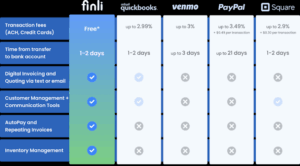
Finli provides financial institutions with the operational platform that replaces the morning patchwork. When a business owner opens Finli’s white-labeled tools, they see invoicing, payment collection, customer management, AR aging, and cash flow visibility in one place, all under your brand.
Automated payment reminders and one-click digital payment links handle collections without the business owner chasing payments manually. AutoPay converts recurring clients to predictable monthly income. 0% ACH processing means payments settle directly into your institution’s accounts with no fees and no holding period. Real-time cash flow data replaces the mental math with actual numbers.
For your institution, being part of the first hour changes everything about the relationship. You’re no longer the 30-second balance check. You’re the ten-minute morning routine where the business owner gets a complete picture of their financial position. That daily engagement creates the kind of operational stickiness that no rate or product promotion can match.
Finli integrates with Q2 and Jack Henry, requires no developer resources, and launches in under 24 hours.
Takeaways
The first hour of a small business owner’s morning is built around answering a handful of urgent questions: did I get paid, who owes me money, what can I afford this week, and what needs my attention today. The tools that answer those questions every morning are the ones that define the business owner’s primary financial relationship.
Financial institutions have an opportunity to become part of that daily routine by providing the operational tools that business owners already need: invoicing, payment collection, customer management, and cash flow visibility. When a business owner starts their day on your platform, checking invoices, reviewing payments, and monitoring cash flow all in one place, you’ve become part of how they run their business.
Finli enables this shift by providing the operational platform that belongs in the first hour. The institutions that show up in the morning routine will build the kind of daily engagement that defines modern small business banking.