
A business checking account in your portfolio shows erratic deposits, a credit line that gets drawn down every few weeks, and a loan payment that processed against an $800 balance last month. From your side of the relationship, this looks like a business trending in the wrong direction. But the business owner knows something you don’t: they have $18,000 in outstanding invoices from clients who are paying 45 days late. The business isn’t underperforming. The cash just hasn’t arrived yet.
This disconnect between what a financial institution sees in account activity and what’s actually happening in the business is one of the most common patterns in small business portfolios. 56% of small businesses are currently owed money from unpaid invoices, with the average outstanding amount at $17,500 per business. From the bank’s perspective, the symptoms look like credit deterioration: thin deposits, rising credit utilization, inconsistent loan payments. But in many cases, the underlying business is sound. The problem is the gap between when customers owe money and when they actually pay it. Recognizing that distinction changes how you assess risk, structure support, and retain clients who might otherwise look like they’re headed for trouble.
(Source: Intuit QuickBooks 2025 Late Payments Report)
Where the Timing Gap Comes From
The cash flow timing gap has several sources, and most of them have nothing to do with how well the business is managed.
Late-paying customers are the biggest driver. The average small business waits 29 days to collect on net-30 invoices, and a significant portion wait 45, 60, or even 90 days. 73% of small businesses report that customer delinquency numbers increased over the past year. A contractor who completed a $15,000 job in March and invoiced promptly might not see that payment until May. In the meantime, they still need to pay their crew, buy materials for the next job, and make their truck payment.
Irregular revenue cycles compound the problem. Unlike salaried employees who receive predictable paychecks, many small business owners experience lumpy income. A property manager might collect most rent payments in the first five days of the month and then have nearly nothing come in for the next 25 days. A consulting firm might receive two large project payments in one week and then wait three weeks for the next. The total revenue over the quarter might be perfectly healthy, but the weekly cash position swings wildly.
Mismatched expense timing adds another layer. Expenses tend to be regular and predictable: rent is due on the first, payroll runs biweekly, subscriptions charge monthly. Revenue arrives irregularly. The contractor’s $15,000 payment might arrive on the 23rd, but their payroll ran on the 15th. This mismatch forces business owners into constant cash flow management, which for many of them means checking their account balance every morning and deciding what they can afford to pay today.
(Source: Gateway Commercial Finance SMB Payment Survey 2025)
The Invisible Cost to Your Institution
Business owners experiencing chronic cash flow timing gaps behave differently in their banking relationship, and the effects show up across your portfolio.
Deposit volatility increases. Instead of steady, predictable deposit activity, accounts show feast-or-famine patterns with large deposits followed by rapid drawdowns. This volatility makes your funding position less stable and makes it harder to assess the business’s actual health from account activity alone.
Credit utilization spikes during timing gaps. Small businesses more affected by late payments are 1.7x more likely to say they’ve become more reliant on credit. They’re drawing on credit lines not because the business is underperforming, but because their customers haven’t paid yet. This utilization looks like increased risk in your portfolio even though the underlying business is sound.
Loan payment timing becomes inconsistent. A business with $12,000 in outstanding invoices and $800 in the account when the loan payment processes isn’t in financial trouble. They’re waiting for money they’ve already earned. But the missed payment still triggers alerts, fees, and potential credit review. The problem looks like credit risk. It’s actually a collection problem.
(Source: Intuit QuickBooks 2025 Late Payments Report)
Solving the Gap at the Source
The most effective approach to the cash flow timing gap doesn’t involve lending. It involves helping the business get paid faster, reducing the friction that causes delays, and creating visibility so the business owner can plan around predictable patterns.
Automated payment reminders and digital payment links address the collection speed problem directly. When an invoice includes a one-click payment option and the system automatically follows up at set intervals, customers pay faster because the friction of paying has been removed. The business owner doesn’t need to spend hours chasing payments manually. Collection times drop, and cash arrives sooner.
AutoPay for recurring clients converts irregular revenue into predictable monthly income. A consulting firm that moves its retainer clients to automated monthly billing eliminates the timing uncertainty for that portion of revenue. A property manager with tenants on AutoPay knows exactly when rent payments will arrive. This predictability transforms cash flow planning from guesswork into something manageable.
Real-time cash flow visibility helps business owners see what’s coming, not just what’s in the account right now. When a business can see outstanding invoices, expected payment dates, and upcoming expenses in one view, they can plan around the timing gap rather than being surprised by it. This visibility also helps relationship managers identify which clients are experiencing timing pressure and offer proactive support.
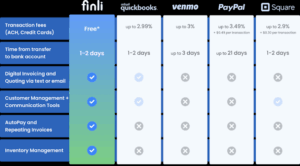
0% ACH processing keeps more of each payment in the business owner’s account. A business processing $30,000 monthly through an external processor at 2.9% is losing $870 per month in fees. During a period when cash flow timing is already tight, eliminating that cost provides immediate relief.
How Finli Closes the Timing Gap
Finli provides financial institutions with the operational tools that address the cash flow timing gap at its source. Integrated invoicing with digital payment links and automated reminders helps businesses collect faster. AutoPay converts irregular revenue into predictable income. 0% ACH processing eliminates the transaction fees that erode cash positions. And real-time cash flow visibility gives business owners and relationship managers the information they need to plan ahead.
When businesses collect payments through Finli’s white-labeled platform, funds settle directly into accounts at your institution. This means faster deposits, more stable balances, and deposit activity that reflects the business’s actual revenue rather than whatever trickled through from external processors.
Finli integrates with Q2 and Jack Henry, requires no developer resources, and launches in under 24 hours.
Takeaways
The account activity your institution sees doesn’t always tell the full story. Many small businesses in your portfolio showing erratic deposits, rising credit utilization, and inconsistent loan payments aren’t in financial trouble. They’re dealing with cash flow timing gaps created by slow-paying customers, irregular revenue cycles, and mismatched expenses. 56% are currently owed money from unpaid invoices. 73% report increasing customer delinquency. The average cost of late payments is $39,406 per business annually.
This timing gap drives deposit volatility, increased credit utilization, and inconsistent loan payments, all of which affect your portfolio even though the underlying businesses are fundamentally sound. The solution isn’t more lending. It’s helping businesses close the gap between earned revenue and collected cash through faster payment collection, automated billing, and real-time visibility.
Finli enables financial institutions to solve this problem by providing the operational tools that accelerate collections, stabilize cash flow, and keep deposits within your institution. The businesses that get paid faster perform better across every metric your institution cares about.