You finished the work. You sent the invoice. And now you’re waiting. The client is happy, the project went smoothly, but the payment? That’s sitting somewhere in their inbox while your rent is due next week and payroll clears on Friday.
Most of the time, this isn’t a client problem. It’s a terms problem. The payment terms you set, when you set them, and how you communicate them have a direct impact on how quickly money lands in your account. Yet many small business owners treat terms as an afterthought, defaulting to Net 30 because it seems standard or skipping the conversation entirely because it feels awkward.
The 2025 QuickBooks Late Payments Report found that over half of small businesses are owed money from unpaid invoices, with 47% of those invoices overdue by more than 30 days. That’s not just an inconvenience. Every week a payment sits outstanding is a week you’re financing your client’s operations with your own cash.
(Source: Intuit QuickBooks 2025 Late Payments Report)
The good news is that tightening your payment terms is one of the fastest, most straightforward changes you can make to improve your cash flow.
Set Your Terms Before the Work Begins
This is the single most important principle in this entire article. The business owner who establishes payment terms at the start of a project is in a completely different position than the one who brings it up after the invoice is sent. Before the work begins, terms are simply part of how you operate. After the work is done, any conversation about terms feels like a negotiation, and you’re negotiating from weakness.
Include your payment terms in three places: your proposal or quote, your contract or service agreement, and your invoice. When terms appear consistently across all three, they stop feeling like something to discuss and start feeling like standard operating procedure.
Know Your Options
Net 30 is the most common payment term in B2B relationships, but it’s not your only option, and it may not be the best one for your business.
Due on Receipt means payment is expected when the invoice arrives. This is the strongest default you can set, and it works well for smaller jobs, new clients, or any situation where cash flow timing is tight.
Net 15 gives the client two weeks to pay. It’s a reasonable middle ground for established relationships. Firm enough to keep cash moving, flexible enough to feel professional.
Net 30 gives clients a full month. It’s common and expected in many industries, but it means you’re carrying the cost of that work for 30 days before you see a dollar. For a small business, that’s significant.
50% Deposit, 50% on Delivery splits the payment so you have cash in hand before you spend anything on the project. This is standard practice across service businesses, construction, consulting, and creative work.
Monthly Retainer means clients pay a fixed amount at the start of each month for ongoing work. You get paid before you work, not after. This is the most predictable cash flow structure you can build.
The right choice depends on your business, your industry, and the specific client relationship. But here’s the key: you get to choose. Payment terms aren’t handed down by some authority. They’re an agreement between you and your client, and you have more room to set them in your favor than you might realize.
Why Deposits Matter More Than Most Owners Think
Requiring a deposit before starting work is one of the most impactful changes a service business can make. It does three things at once.
First, it brings cash into your account before you spend anything on the job. You’re no longer funding the entire project yourself while waiting 30 or 45 days for payment. Second, it signals client seriousness. A client who pushes back hard on a reasonable deposit for a meaningful project is worth paying attention to. Third, it creates shared commitment. Clients who have made a deposit tend to be more responsive during the project and more prompt on the final payment.
A 25-50% deposit is standard across industries. For smaller jobs under $500, a deposit may not be worth the friction. For anything larger, it changes the cash flow equation significantly. If you’re nervous about requiring deposits because you think it will cost you clients, consider this: most professional clients expect it. The ones who resist strongly are often the ones who would have been difficult to collect from anyway.
Use Specific Due Dates, Not Vague Terms
“Due upon receipt” sounds clear, but it’s open to interpretation. “Net 30” tells the client roughly when to pay, but it requires them to do the math. “Due by April 15” is specific, concrete, and creates an actual deadline.
Whenever possible, put a specific calendar date on your invoices instead of (or in addition to) your net terms. Specific dates get acted on. Vague terms get deferred.
Make Paying You as Easy as Possible
Even with perfect terms, payments slow down when there’s friction in the actual payment process. If a client receives your invoice and has to look up your banking details, write a check, or log into a separate portal to pay, each of those steps creates delay.
The faster approach is embedding a payment link directly in your invoice. One click, and they’re done. Removing friction is one of the simplest ways to close the gap between “invoice sent” and “payment received.”
How Finli Helps You Get Paid on Your Terms
Setting strong payment terms only works if your invoicing system supports them. Finli makes it easy to put these practices into action without adding administrative work to your plate.
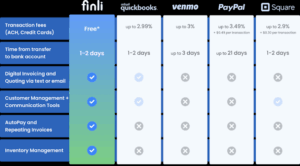
Every invoice you send through Finli includes a direct payment link, so clients can pay the moment they open it. No hunting for account numbers, no logging into a separate system. That one-click experience removes the friction that turns a “I’ll pay this today” into a “I’ll get to it next week.”
Automated payment reminders handle the follow-up that most business owners avoid or forget. Finli sends professional reminders at the right intervals, before and after due dates, so you don’t have to send awkward emails or track who owes what in a spreadsheet.
For recurring clients, Finli’s Autopay lets customers set up automatic payments on their preferred schedule. You set the terms once, and payments arrive automatically each month. That predictable revenue becomes the foundation your business can operate from with confidence, while the rest of your project-based income follows your standard terms.
Real-time invoice tracking shows you exactly when clients view your invoices, when payments are processing, and when funds hit your account. You always know where your money stands, which makes it easier to plan around your actual cash position instead of guessing.
Every feature comes included at $39/month with 0% ACH fees, so the system that helps you enforce better payment terms doesn’t cut into your margins.
Takeaways
Getting paid on time starts before you do the work. Set your terms upfront, include them in your proposals and contracts, and communicate them clearly on every invoice. Choose terms that match your cash flow needs rather than defaulting to what seems standard. Require deposits on meaningful projects. Use specific due dates. And make the act of paying you as simple and frictionless as possible.
The businesses that get paid consistently aren’t necessarily doing different work. They’ve just built systems where payment isn’t an afterthought. It’s part of how they operate from day one.
Ready to put better payment terms into practice? Get started at finli.com or reach out to our team at support@finli.com.