
You ring up a $100 sale, the customer’s card gets approved, and you assume $100 is on its way to your bank account. Then your deposit arrives a few days later and it’s $97.20. Or $96.50. Or sometimes $95.80. The amount varies, and you’re never quite sure why.
This uncertainty isn’t just annoying. It’s a cash flow problem. When you’re operating on tight margins and every dollar matters, these invisible hands reaching into your revenue before it hits your account can mean the difference between making payroll comfortably and scrambling to cover expenses.
The average small business pays between $3,500 and $5,000 annually in credit card processing fees, but most owners can’t explain exactly where that money goes or why the amount fluctuates from transaction to transaction. You’re forced to accept credit cards to stay competitive, but you won’t know what you’ll actually receive until you check your statement days later.
Understanding what happens between “payment approved” and “money in your account” won’t entirely eliminate these costs, but it will help you anticipate them, negotiate better, and make smarter decisions about how you accept payments.
What’s Actually Happening When a Customer Swipes Their Card
The moment a customer taps, swipes, or inserts their card, an invisible process involving multiple companies kicks off. Each one takes a cut before you see a dime.
The card networks (Visa, Mastercard, Discover, American Express) facilitate the transaction between banks. They charge network fees, typically 0.1% to 0.2% of each transaction.
The issuing bank gave your customer their credit card. They take the largest single cut, called the interchange fee, which ranges from 1.5% to 3.5% depending on the card type. A rewards card with generous cashback costs you more to process than a basic card because the issuing bank needs to fund those rewards somehow. They’re doing it with your money.
The acquiring bank processes payments on behalf of your business. They provide the infrastructure that connects you to the card networks and charge a markup on top of the interchange fees.
The payment processor handles the technical side of authorization, settlement, security, and reporting. They charge either a percentage fee, a flat fee per transaction, or both.
Your payment gateway (if processing online) provides the secure connection between your website and the payment processor. Another fee, usually $0.10 to $0.30 per transaction.
Every single one of these entities takes a cut before you receive your money. And here’s the frustrating part: you don’t control most of these fees, and they vary based on factors you often can’t predict.
Why Processing Fees Fluctuate
Even if you charge the same amount for every sale, your processing costs will vary because different cards carry different interchange rates. A customer paying with a basic debit card might cost you 1.5% in fees. Another customer using a premium rewards credit card could cost you 3.2%. You charge the same price, but you keep different amounts depending on what’s in your customer’s wallet.
Factors that affect your fees:
Card type: Debit cards cost less than credit cards. Basic credit cards cost less than rewards cards. Corporate and business cards often carry the highest fees.
Transaction method: Card-present transactions (in person) cost less than card-not-present (online or phone) because they carry lower fraud risk.
Business type: Some industries are considered higher risk and pay higher rates.
Transaction size: Some processors charge higher percentages on small transactions, while others add flat fees that eat up a larger percentage of low-dollar sales.
The result? You won’t know your exact take-home until you review your processing statement, which typically arrives after the money has already been deposited. You’re essentially running your business with estimated cash flow rather than predictable numbers.
Why Your Money Isn’t Available Immediately
Your customer’s payment gets approved instantly. You see “transaction successful” on your screen. So why doesn’t the money hit your account right away?
The authorization you see during a transaction isn’t the same as settlement. Authorization just confirms that your customer has sufficient funds or credit. The actual movement of money happens later, through a batch settlement process.
Here’s the typical timeline:
Day 1: Customer pays. The transaction gets authorized and added to your daily batch. At end of day, all transactions get submitted to your processor for settlement.
Day 2: Your processor requests funds from the issuing banks. The card networks facilitate this transfer. Your acquiring bank receives the funds.
Day 3: Your acquiring bank deposits the funds (minus all fees) into your business bank account.
This 2-4 day delay is standard for credit card processing. For ACH bank transfers, the timeline is similar: 2-4 business days from when your customer initiates payment to when you can access the funds.
What This Means for Your Already Tight Margins (With Traditional Processors)
When you’re using traditional payment processors, small businesses operate on an average net profit margin of 7-10% while paying 2.5-3% in variable credit card processing fees. Those fees can represent 25-40% of your entire profit margin.
Let’s say you run a service business that generates $75,000 annually with a 10% net profit margin ($7,500 in profit). If you process $60,000 of that through credit cards at an average 2.7% fee with a traditional processor, you’re paying $1,620 in processing costs. That’s more than 20% of your profit going to payment processing.
For businesses with tighter margins like freelance consultants or contractors operating at 8-10% net profit, every percentage point in processing fees directly impacts what you can actually take home at the end of the year. And because those fees fluctuate based on which cards your customers use, you can’t predict them accurately.
How Finli Solves This Problem
Everything described above about variable fees, multiple intermediaries taking cuts, and uncertainty about what you’ll actually receive is how traditional payment processors operate. Finli works completely differently.
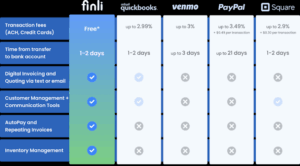
Finli charges a flat 3% fee on every credit card transaction. Not 1.5% on one transaction and 3.5% on another. Not surprise fees that vary based on card type. Just 3%, every single time.
Here’s what makes this different:
Predictable costs you can actually forecast: When you know every credit card transaction costs exactly 3%, you can budget with confidence. A $1,000 invoice paid by credit card means you receive $970. A $5,000 invoice means you receive $4,850. No surprises, no waiting for your statement to see what actually arrived.
You control who pays the fee: With Finli, you decide whether to absorb the 3% processing fee yourself or pass it on to customers. Many service businesses, consultants, and freelancers add the processing fee as a line item, especially for larger invoices. Your customer sees the transparency, and you protect your margins.
True 0% ACH fees: When customers pay via bank transfer instead of credit card, you pay absolutely nothing. Zero processing fees. For recurring payments or larger invoices where customers don’t need credit card float, encouraging ACH payments means you keep every single dollar.
Real-time visibility into exactly what you’re getting: Finli shows you the exact amount you’ll receive before processing any transaction. No guessing, no estimating, no waiting three days to find out what survived the fee gauntlet.
How This Changes Your Cash Flow Reality
With traditional processors, you’re constantly doing mental math. “If 60% of my customers use rewards cards, and 30% use basic cards, and 10% use debit cards, then my average fee is probably around 2.7%… I think?”
With Finli, the math is simple. Credit card payment? 3%. ACH payment? 0%. Done.
This predictability transforms how you manage cash flow. You know exactly how much revenue you need to hit your profit targets. You can decide strategically which payment methods to encourage. You can offer customers the choice to pay the processing fee, turning what was an invisible cost into a transparent line item.
For a business processing $10,000 monthly in credit card payments, here’s what Finli’s model means:
Monthly processing fees: $300 (flat 3%)
If you pass fees to customers: $0 in processing costs, and your customers pay an additional $300 total across all transactions
If you shift 40% to ACH: $180 in credit card fees on $6,000, $0 on the $4,000 paid via ACH, total monthly cost of $180 instead of $300
You’re in control. You know the numbers before processing. You decide who pays the fee. And you can finally forecast cash flow without crossing your fingers and hoping the processing statement doesn’t destroy your margins.
The First Step Is Understanding, The Second Is Choosing Better
The complexity of traditional credit card processing isn’t an accident. The more confusing it is, the harder it becomes to comparison shop or identify when you’re overpaying.
Your job isn’t to become a payment processing expert. It’s to understand how traditional processors work, recognize the unpredictability problem they create, and choose a platform that eliminates it.
Understanding that traditional processors charge variable fees based on card types, intermediary cuts, and business risk categories helps you recognize why your deposits fluctuate. But understanding alone doesn’t fix the problem. You need a different model.
Takeaways
Start by auditing your actual processing costs with your current provider. Calculate your effective rate (total fees divided by total volume processed) over the last three months. Many businesses discover they’re paying more than they thought, with rates fluctuating between 2.5% and 3.5% depending on which cards customers happened to use.
Then evaluate whether that unpredictability is costing you more than just the fees themselves. Are you padding estimates to account for uncertainty? Missing opportunities because you can’t confidently forecast cash flow? Absorbing costs you could be passing to customers if you had transparent pricing to show them?
Finli eliminates the guesswork entirely. Flat 3% on credit card transactions with the option to pass fees to customers, 0% on ACH payments, and real-time visibility into exactly what you’ll receive from every transaction. Every feature (invoicing, payment processing, automated reminders, and customer management) comes included at $39/month with no surprise fees buried in fine print.
The businesses that master cash flow aren’t the ones avoiding credit cards or accepting unpredictable fees. They’re the ones who understand what traditional processors are doing and choose platforms that give them control, transparency, and predictability instead.
Understanding what happens to your money between “payment approved” and “money in your account” is the first step. Choosing a payment platform that lets you keep more of it is the second.