
Between serving customers, managing operations, and handling the usual year-end demands, finding time to review your finances can feel impossible. But carving out a few hours now pays off. A clear picture of your 2025 numbers helps you spot patterns in your spending, catch expenses that crept up unnoticed, and identify opportunities you might otherwise miss.
This guide walks you through what to examine, what patterns to look for, and how to turn your 2025 numbers into better decisions for 2026.
Revenue, Expenses, and Cash Flow
Start with what came in. Which products or services drove the most income? Which customers generated the highest value? Many business owners discover that 20-30% of their offerings generate 70-80% of their revenue. Knowing this helps you decide where to focus in 2026.
For expenses, identify categories that grew faster than revenue. That’s margin compression, and it needs attention. Pay special attention to subscriptions. Most businesses accumulate software tools without evaluating whether each still provides value. Auditing recurring charges often reveals hundreds in annual savings from services you forgot you were paying for.
Cash flow deserves particular scrutiny. Research shows 70% of small businesses hold less than four months of cash reserves, and 45% of owners have skipped their own paychecks due to cash shortages. Understanding when money actually enters and leaves your account reveals whether your business can weather slow periods.
(Source: PYMNTS Intelligence)
The Receivables Problem
Outstanding invoices represent cash you’ve earned but can’t use. Small businesses wait an average of 29 days to get paid, and that stretches longer when customers pay late. The longer an invoice sits unpaid, the less likely you’ll collect the full amount.
December is your last chance to collect 2025 revenue before it becomes a 2026 problem. Contact every customer with balances over 30 days past due. Many businesses recover 15-25% of aged receivables simply by making personal contact before year-end.
Payment Processing Costs
Payment processing fees are easy to ignore because they’re deducted automatically. But those percentages add up. If you processed $100,000 in card payments at 2.9%, you paid $2,900 in fees. That’s real money that could have stayed in your business.
ACH bank transfers typically cost significantly less than credit cards, often under 1% compared to 2.5-3.5% for cards. If most of your customers could pay via ACH but you haven’t offered that option, you may be losing thousands annually in unnecessary fees.
Profit Margins and Tax Documentation
Revenue growth means little if costs grow faster. Calculate your actual profit margins and compare them to previous years. The recommended margin for small businesses ranges between 7% and 10%, though this varies by industry. If your margins contracted in 2025, identify the cause. Did costs rise faster than you adjusted prices, or did you take on lower-margin work to maintain volume?
For tax preparation, verify you have documentation for every deduction you plan to claim. The IRS requires proof of business expenses, and missing receipts mean lost deductions. Keep records for at least seven years in case of an audit.
How Finli Makes Year-End Reviews Simple
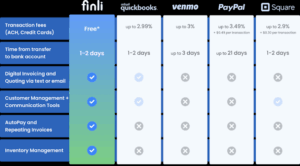
Small business owners handling finances manually spend 3-6 hours per week on invoicing, reconciliation, and tracking. Much of what makes year-end reviews painful is piecing together information from scattered sources. Finli eliminates that problem by keeping everything in one place, updated in real time, organized automatically.
Real-time payment visibility shows exactly which invoices are outstanding and who’s paid at any moment. You can sort customers by total revenue, see payment patterns at a glance, and identify your highest-value relationships without pulling data from multiple systems.
Automated payment reminders handle collection follow-up without requiring your attention. Finli sends professional reminders at issue date, due date, and intervals past due. This reduces the aged receivables that complicate year-end reviews.
Built-in customer records track every invoice, payment, and interaction. QuickBooks integration syncs everything automatically, so there’s no double entry required. Your books stay current throughout the year, making reconciliation a quick verification rather than an hours-long project.
And with 0% ACH fees, you’re not losing money to payment processing costs. Every feature (invoicing, payment processing, CRM, automated reminders) comes included at $39/month.
Setting Targets for 2026
The real value of a year-end review isn’t just knowing what happened. It’s using that knowledge to make better decisions. Rather than vague goals like “increase revenue,” establish concrete benchmarks: reduce average days to payment from 35 to 25, improve gross margin from 42% to 45%, or decrease subscription costs by $200 per month.
Specific targets give you something to measure against throughout the year, helping you catch problems early rather than discovering them at next year’s review.
Takeaways
Your year-end financial review reveals where money flows, where it stalls, and where you’re leaving value on the table. Work through revenue, expenses, cash flow, receivables, and margins. Document everything for tax preparation, and use what you learn to build systems that maintain visibility year-round.
The businesses that enter 2026 with clarity are the ones that took time now to understand their 2025 numbers. Set aside time this week to begin. Your future self will thank you.