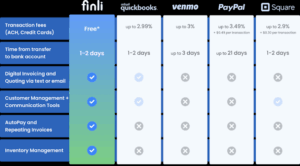

Your small business clients are ending 2025 exhausted and paying an average of $340 monthly for disconnected financial tools that barely talk to each other. While you’ve watched their deposit activity decline, they’ve quietly built their operational infrastructure on platforms outside your institution—Square processes their payments, QuickBooks manages their invoicing, and PayPal handles their transactions.
This isn’t just deposit leakage—it’s a strategic vulnerability. The financial institutions that enter 2026 with only traditional banking products will find themselves competing on rates and fees alone. Those that position themselves as integral operational partners will capture relationships that competitors can’t replicate, setting themselves up to win throughout 2026 and beyond.
You can launch Finli in under a month, so the time to act is now. With no integration required, you’re still able to roll out a fully white-labeled solution in time to capture this year-end planning window.
The window to reposition begins right now. Small businesses plan their 2026 operations in these final weeks, making decisions about which platforms will power their growth. Financial institutions that provide comprehensive operational solutions during this planning period position themselves as indispensable partners rather than interchangeable service providers.
Understanding Your True Competition
Most financial institutions naturally focus on traditional competitors—comparing loan rates, account features, and branch networks against other banks. While this matters, it doesn’t capture the complete picture of what’s reshaping small business banking today.
The biggest competitive challenge isn’t the credit union across town. It’s the operational platforms that small businesses use dozens of times daily while their bank account sits relatively untouched.
84% of SMBs in the U.S. now use at least one fintech service. This reveals an important shift: small businesses aren’t just choosing between banks anymore. They’re deciding whether to keep a passive banking relationship or move to platforms that solve their daily operational challenges. When a contractor processes $50,000 monthly through Square while maintaining a minimal balance in your account, they’ve found value elsewhere—not necessarily because your banking products failed, but because their operational needs went unmet.
(Source: Coin Law)
Square doesn’t just process payments, it provides inventory management, employee scheduling, and analytics. QuickBooks generates invoices, manages vendor payments, and forecasts cash flow. These platforms recognized that small businesses need operational solutions as much as they need banking products.
The challenge intensifies as the gap widens. Every payment processed outside your ecosystem generates insights that other providers use to identify lending opportunities. Every invoice sent through external platforms creates cash flow visibility that enables better-timed credit offers. By the time you recognize a small business needs working capital, platform-based competitors may have already extended pre-approved offers based on months of performance data.
Why January 2026 Creates Strategic Advantage
Business owners enter the new year with renewed energy, cleaned-up books, and genuine motivation to improve operations. They evaluate their existing tool stack, assess what worked in 2025, and make deliberate choices about which platforms will support their 2026 growth.
Small businesses that struggled with fragmented operations throughout 2025 are actively seeking better alternatives. A contractor tired of reconciling payments across three platforms is motivated to consolidate. A professional services firm frustrated with late-paying clients wants automated collection systems. A property management company juggling tenant payments and vendor disbursements needs integrated financial tools.
Business owners making strategic decisions right now will stick with those choices throughout the year. The platform they select in January becomes their payment processor for 2026. The invoicing system they implement during year-end planning handles their receivables for twelve months.
This alignment of timing and need creates adoption rates that mid-year campaigns can never match.
What Small Businesses Actually Need for 2026
Small business owners aren’t kept up at night worrying if they have the right checking account type. They worry about $12,000 in outstanding invoices that should have been paid weeks ago. They stress about 14 hours weekly spent on administrative tasks instead of revenue-generating activities. They’re frustrated by $340 monthly for tools that don’t work together and transaction fees that erode thin margins.
When you offer solutions that address critical vulnerabilities like cash flow, you’re solving problems that directly impacts their ability to make loan payments. When you provide tools that reduce administrative burden, you’re giving business owners time to focus on growth. When you eliminate unnecessary transaction fees, you’re proving you understand their operational reality.
Four Critical Capabilities Small Businesses Need
Payment Processing That Eliminates Friction: Integrated payment processing with competitive fees and same-day settlement solves real problems while protecting deposit relationships. Small businesses currently wait 2-3 days for funds while paying 2.6-3.5% in fees.
Automated Receivables Management: The average small business waits 29 days to collect on net-30 invoices, with many taking 60-90 days. Tools that automate invoice generation, enable one-click payments, and send strategic reminders transform this dynamic completely.
Integrated Business Management: Small businesses juggle separate systems for invoicing, payment processing, CRM, and reporting. Each platform costs money, creates data silos, and demands reconciliation. Integrated solutions eliminate these headaches.
Real-Time Business Insights: Most small businesses operate with outdated financial information. Integrated operational tools generate real-time visibility into revenue patterns, payment behaviors, and cash flow trends.
Why Operational Integration Creates Higher Relationship Value
Traditional banking products—business checking accounts, merchant processing, and term loans—remain important foundations for small business relationships. However, these products alone face increasing pricing pressure as businesses can find similar offerings at multiple institutions.
A business checking account typically generates $200-400 annually in fee income. Standard merchant processing adds a few hundred dollars more. These relationships remain profitable, but they’re also vulnerable to rate competition.
Compare this to relationships built on operational integration. Small businesses using comprehensive platforms through their financial institution typically generate 3.2x more revenue through expanded service utilization, higher deposit balances, increased fee income from integrated tools, and stronger loan relationships based on real-time performance data.
(Source: American Bankers Association Commercial Banking Survey)
When a business processes payments, manages invoices, and tracks customer relationships through your platform, they’ve woven your institution into their daily operations. This creates natural retention that goes beyond rate competition—businesses value the operational efficiency you provide, making switching costs about much more than just moving an account.
How Finli Enables Your 2026 Strategy
Finli provides financial institutions with the operational platform that transforms small business banking from transactional to transformational. Rather than forcing you to choose between relationship banking and modern capabilities, Finli delivers both through a comprehensive white-labeled solution.
Zero-Fee Payment Processing: 0% ACH fees eliminate transaction costs that drain $340 monthly from small business margins while keeping all deposits flowing directly into accounts at your institution.
Accelerated Cash Flow: : Automated invoicing and payment collection dramatically accelerates cash flow by making it easy for customers to pay instantly with one-click options, solving the receivables problem that creates irregular loan payments.
Consolidated Business Tools: Integrated CRM consolidates the business tools that small businesses currently pay for separately, reducing both costs and operational complexity.
Real-Time Intelligence: Business intelligence provides insights that help owners make better decisions while giving your institution unprecedented visibility into client financial health.
Finli operates entirely under your brand through white-label deployment. Prebuilt integrations with Q2 and Jack Henry enable seamless implementation, while the “Try Before You Integrate” approach lets you launch branded business services and measure adoption before deeper technical integration.
The platform creates natural, daily touchpoints with your small business clients. When they send invoices, process payments, or check cash flow metrics, they’re actively engaging with your institution’s branded platform—generating operational data that enables truly consultative conversations about credit needs and growth planning.
The Cost of Waiting
Every week financial institutions delay implementing comprehensive operational strategies represents another week competitors capture small business relationships. The businesses making infrastructure decisions right now won’t reconsider those choices for at least a year.
Financial institutions that wait for perfect conditions will spend 2026 recovering ground rather than gaining it. While you’re planning, more agile competitors are executing. While you’re debating implementation, fintech platforms are signing up the small businesses you should be serving.
A community bank that could serve 100 new small business clients monthly with competitive operational tools loses 1,200 potential relationships through a year of inaction. At average annual revenue of $2,000-3,000 per integrated relationship, that delay costs $2.4-3.6 million in first-year revenue alone.
Perhaps more critically, delayed implementation allows competitors to establish operational relationships that create substantial switching barriers. When a business has built their 2026 operations around a competitor’s platform, your promotional checking account offers become irrelevant.
Takeaways
The financial institutions that enter 2026 with competitive small business strategies will recognize operational integration as the foundation for lasting relationships. Small businesses don’t need more commodity banking products—they need solutions that help them collect payments faster, reduce administrative burden, and keep more of what they earn.
Finli enables this strategic shift by providing white-labeled operational platforms that solve real business problems while strengthening banking relationships. Payment processing with 0% ACH fees, automated receivables management, integrated business tools, and real-time insights create value that commodity banking products cannot match.
The competitive window remains open but narrows daily as businesses finalize their 2026 operational plans. Financial institutions that act now position themselves to capture relationships that competitors spending 2026 in planning mode will never reach.
The choice is clear: enter the new year with a strategy that’s already ahead of your competition, or spend another year watching small business relationships fragment across platforms that understand what you haven’t—that operational value creates banking relationships, not the other way around.